
“Both sections warmed slowly even after the condenser was cleaned: 47°F fresh food and 24°F freezer. The technician recorded amperage, pressure evidence and frost pattern before quoting. The sealed-system repair was $2,460, completed over 2 visits, and the freezer reached 0°F after recovery.”
4.9/5 network rating372 verified repairs
Napa · Sealed Refrigeration Circuits
Sub-Zero Sealed System & Compressor Repair in Napa
How do you tell if a Sub-Zero needs sealed-system or compressor repair in Napa?
Both compartments warming together, or a compressor that runs without pulling temperature down, points toward the sealed system — but Napa Sub-Zero Repair confirms it only with manifold pressure and amperage readings, never appearance. For Silverado estates in 94558 we document the proof first; call (628) 209-6820.
When a Sub-Zero's fresh-food section runs warm while the freezer still holds — or when both sides drift together — the sealed system is worth investigating. Napa Sub-Zero Repair diagnoses and repairs Sub-Zero compressors, condenser assemblies, capillary restrictions and refrigerant circuits for homes across downtown Napa and the surrounding wine country. Napa's hot summers push condenser load harder than coastal climates do; that context shapes every diagnosis. Use Book Online with your model number to schedule a Sub-Zero-specific diagnostic visit.
Sealed-system work is EPA-regulated and confirmed with pressure and temperature readings before any quote. We do not guess compressor faults from the display.
Ice Maker & Temperature
When the ice maker is slow, jammed, or producing hollow cubes
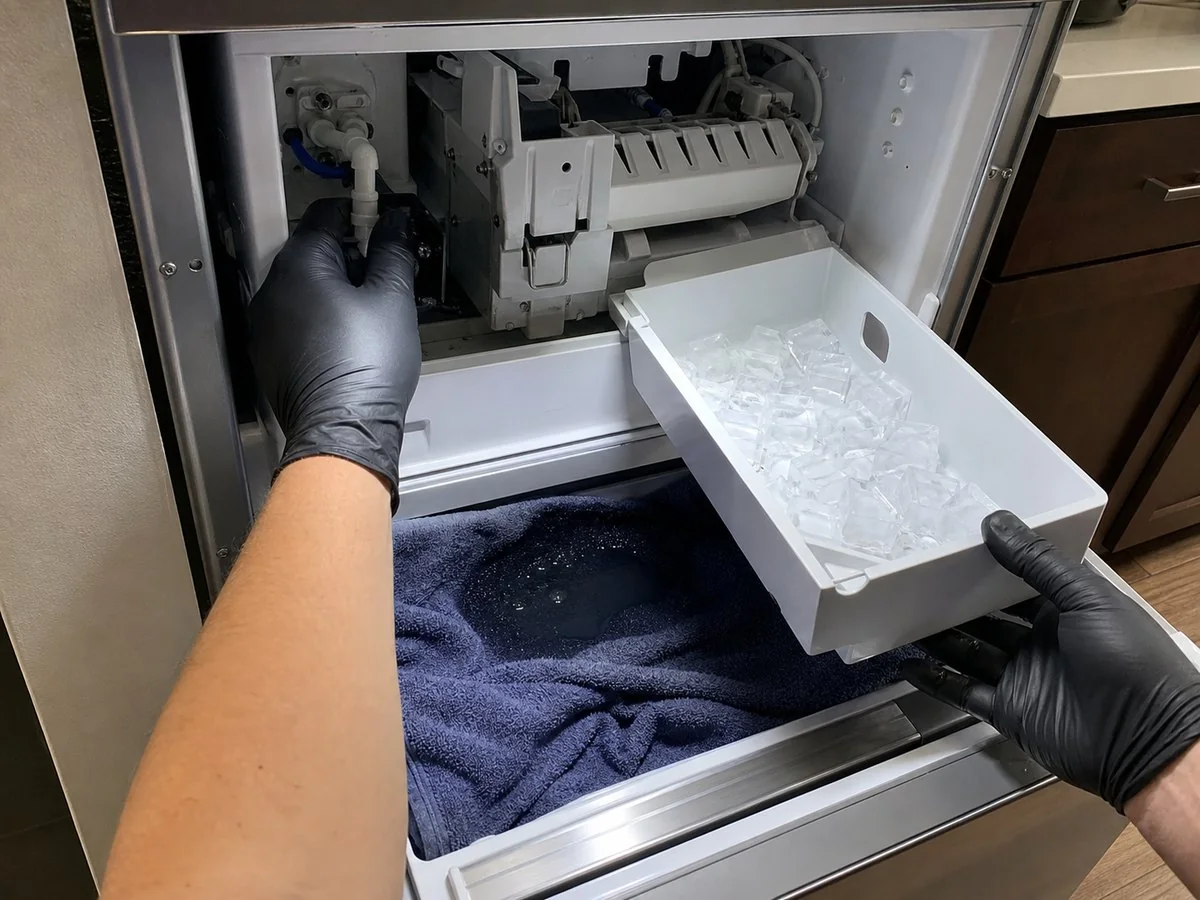
Hollow cubes and slow ice output feel like ice-maker problems — and often they are. A weak water inlet valve, a partially frozen fill tube, low household water pressure, or a clogged inline filter each produces the same symptom without any involvement from the sealed system. Diagnosis confirms this by measuring actual freezer compartment temperature: if the freezer is holding its set point correctly, the sealed system is cleared from suspicion and the investigation moves to the water side.
The limitation: when the freezer itself runs too warm, ice production slows or stops entirely because the harvest cycle cannot complete at inadequate cold. A warm freezer section also produces hollow cubes — the center of each cube does not freeze before harvest. In this case the ice maker is responding correctly to an underlying temperature problem; replacing the ice-maker module alone will not resolve it. That distinction — ice-maker fault versus temperature-driven ice fault — is what a proper Sub-Zero diagnosis separates before any parts are ordered. See the full ice maker & water line guide for the water-side walkthrough.
Regulatory Boundary
Refrigerant work is federally regulated — here is what that means in practice
EPA Section 608 — No DIY refrigerant access
Under Section 608 of the Clean Air Act, intentionally venting regulated refrigerants (including HFCs such as R-134a and HFOs used in newer Sub-Zero units) is a federal violation. Purchasing refrigerants in quantities appropriate for appliance repair requires EPA 608 certification. There are no legal workarounds for residential DIY refrigerant work on sealed appliance systems.
Do not attempt the following without proper recovery equipment and legal credentials: opening a refrigerant line or service valve; adding or "topping off" refrigerant; soldering or brazing refrigerant tubing; replacing the compressor, filter-drier or capillary tube; or pressure-testing with refrigerant. These actions require proper recovery equipment, proper handling of recovered refrigerant, and pressure-testing with dry nitrogen before recharge.
What is safe to check yourself: condenser cleanliness (vacuum the grille coil), whether condenser and evaporator fans run, whether the unit has power and the display is functioning, and whether door gaskets seal correctly. Everything beyond those checks on the sealed circuit is technician territory.
Diagnostic Reference
Symptom-to-component table for Sub-Zero sealed-system diagnosis
Eight faults, ranked from the most accessible (non-sealed) to full sealed-system work. Sealed-system rows are marked — they require EPA-regulated access and are not owner-serviceable.
| Symptom | Possible component | Confirmation test | False-positive to avoid | Repair path |
|---|---|---|---|---|
| Both sections run warm; unit runs continuously; condenser very hot to touch | Condenser overload — coil packed with dust, poor ventilation, or fan inoperative | Measure condenser outlet temperature; inspect coil visually for lint/debris; confirm fan blade spins freely under power | Do not conclude refrigerant leak before cleaning condenser and confirming fan operation — a dirty condenser in a Napa summer can mimic low-charge symptoms completely | Condenser cleaning + fan replacement if needed. Non-sealed; no EPA certification required for this step |
| Condenser fan does not run; compressor cycles on thermal overload | Condenser fan motor or blade (upper compartment, grille area) | Confirm voltage at fan terminals; check blade for obstruction; test motor winding continuity | Do not assume compressor failure — a compressor that trips its overload due to condenser heat is often mechanically sound once airflow is restored | OEM fan motor replacement. Non-sealed work; straightforward on most BI series and integrated models with grille access |
| Fresh-food side warm; freezer holds; back wall of fresh-food section frosts or is warm | Evaporator fan (fresh-food side) or defrost heater leaving evaporator blocked with ice | Remove rear panel; check fan for power and rotation; read evaporator temperature; inspect for frost block | Do not attribute this to a compressor fault — on dual-refrigeration units the fresh-food circuit is independent; the freezer running normally rules out compressor failure on that side | Fan motor replacement or defrost heater/thermostat replacement. Non-sealed work |
| Unit runs but neither section cools; both evaporators frost heavily or not at all | Defrost system failure (heater, thermostat, timer/control) causing frost block on evaporator | Read evaporator temperature; confirm heater resistance; check defrost thermostat opens at rated temp; review defrost cycle timing via control board | Do not interpret complete frost block as a sealed-system fault before the defrost circuit is tested — a blocked evaporator restricts airflow identically to low refrigerant charge in terms of cabinet temperatures | Defrost heater, thermostat or control board replacement. Non-sealed work |
| Compressor runs continuously; unit underperforms but does not reach target temp; high suction pressure | Capillary tube restriction or filter-drier contamination (sealed-system component) | Read suction and discharge pressures with gauge set; compare to spec for refrigerant type; high suction + warm box suggests restriction | Restriction symptoms overlap with refrigerant overcharge — do not add charge before pressure readings confirm the fault is restriction rather than excess refrigerant | EPA-regulated Sealed-system access required: recover refrigerant, replace filter-drier and capillary, pressure-test, recharge to spec weight |
| Unit gradually loses cooling over weeks; compressor runs long cycles; oil staining near fittings or evaporator joints | Refrigerant leak (pinhole in evaporator, fitting, or brazed joint) | Electronic leak detection at all joints; UV dye trace where applicable; confirm low charge via pressure readings | Do not simply recharge without locating and repairing the leak — a recharged system with an active leak will fail again within weeks to months | EPA-regulated Locate leak, braze or replace the leaking component, pressure-test with nitrogen, evacuate, recharge to rated weight |
| Compressor clicks on then immediately off; start relay rattles or shows burn marks; or compressor hums but does not start | Compressor start relay, overload protector, or start capacitor (electrical side of compressor) | Remove and shake start relay — a rattling relay is failed; test overload continuity; measure starting capacitor if equipped | Do not condemn the compressor until electrical components are tested — a dead start relay produces the same silent-compressor or click-off pattern as a seized compressor, at a fraction of the repair cost | Start relay and/or overload replacement — non-sealed electrical work. If electrical tests pass and compressor still fails to start or run: sealed-system investigation warranted |
| Compressor is silent when it should run; correct voltage present; start relay and overload test good; no pressure on gauges | Compressor mechanical failure (seized or open winding) | Megohm-test winding insulation; confirm continuity through common, run and start windings; pressure-equalize and attempt start; read locked-rotor amperage | Do not replace the compressor on a visual or auditory inspection alone — a silent compressor may be a failed start component; confirm via electrical testing and pressure readings before quoting compressor replacement | EPA-regulated Full sealed-system replacement: recover refrigerant, replace compressor, filter-drier and relevant tubing, pressure-test, evacuate, recharge. Highest-cost repair; justify with written evidence before approving |
Model-Specific Notes
How sealed-system diagnosis changes by Sub-Zero family
Confirm your model and serial before any repair conversation. Sub-Zero part numbers, refrigerant types, and system configurations are series-specific — the following notes apply only to the families named, and only when verified by the tag.
BI Series — Dual Refrigeration (e.g., BI-36U, BI-48S, BI-42S)
BI-series units with dual refrigeration run two independent sealed circuits: one for the fresh-food section, one for the freezer. A warm fresh-food side with a cold freezer means the fault is isolated to the refrigerator circuit — the freezer compressor and evaporator are not involved. This is a critical diagnostic split: do not quote a full sealed-system overhaul when only one circuit has failed. Verify which compressor is at fault by checking both circuits separately. Refrigerant type varies by production year; confirm from the model tag before any recovery or recharge.
Single-Compressor Units (e.g., 611, 632, 650, 695)
Older and some mid-range Sub-Zero models use a single compressor serving both the fresh-food and freezer sections via a common sealed system. On these units, both compartments will warm together when the sealed system fails — there is no independent circuit to isolate. Condenser and fan checks still come first, but the diagnostic path is different from dual-circuit models. Confirm the unit's compressor count from the serial data before discussing repair options.
PRO Series (e.g., PRO 48, PRO 36)
PRO-series units are large dual-compressor configurations with high-capacity condensers designed for heavy use. The condenser assembly is significant; in Napa's hot-summer conditions and in wine-country estates where kitchens are large but ventilation varies, condenser load is a first-priority check before any sealed-system conclusion. The PRO series uses variable-speed compressor technology on some configurations — confirm via model tag and service documentation before applying standard compressor electrical tests.
Integrated Series (e.g., IC 27, ID 30, IT 24)
Integrated columns are designed for flush cabinetry installation, which creates a tighter thermal environment than freestanding units. Condenser access is through the front grille panel, and the pathway for heat dissipation is deliberately restricted by the cabinet surround. In older Napa homes — particularly the craftsman and Victorian-era houses near the Oxbow Public Market area — inadequate grille clearance or cabinetry that was fitted too tightly is a common root cause of condenser overload that reads like sealed-system failure. Verify grille clearance before condemning the circuit.
Classic 500 Series (e.g., 511, 532, 561)
Legacy 500-series units are still running in Napa kitchens that have not been remodeled. These are older sealed systems using refrigerants that may have been phased down in production; confirm refrigerant type before recovery planning. Parts availability has tightened for some 500-series components — this is a relevant factor in the repair-vs-replace decision for older 500-series units undergoing compressor failure. Verify serial-range-specific service documentation before quoting.
600 Series (e.g., 611, 632, 650, 695)
The 600 series spans a wide production range. Earlier 600-series models share sealed-system architecture with the 500 series; later revisions introduced electronic controls and updated condenser configurations. The diagnostic approach differs enough between early and late 600-series serial ranges that the serial number — not just the model number — must be confirmed before parts are ordered. Wine-column variants in the 600 series (such as the 424 and 427) use a dedicated cooling circuit; temperature drift in these units is addressed on the wine storage drift page.
Evidence & Local Context
What a sealed-system diagnosis actually documents in Napa
A sealed-system verdict is not a hunch. Every quote for refrigerant or compressor work at Napa Sub-Zero Repair is backed by written evidence: temperature readings taken at the fresh-food and freezer compartments with a calibrated thermometer, condenser and evaporator photographs showing actual frost patterns and coil condition, and model-tag proof confirming the exact Sub-Zero variant and the refrigerant type called for. OEM fan, gasket, and control-board evidence is documented the same way so you can see why a specific part was ordered rather than an aftermarket substitute.
This matters especially in downtown Napa and the Oxbow Public Market area, where older homes with original cabinetry sometimes have built-in Sub-Zero units that have run for 20-plus years without a condenser service. A wine column drifting several degrees from its set point in those installations is often a condenser-load problem, not a failing compressor — and the distinction is exactly what temperature and pressure readings separate. For wine-country estates where collections run to hundreds of bottles, we treat temperature verification as non-negotiable before any sealed-system quote. The Napa case notes show how that evidence and the measured outcome are recorded job by job.
Pricing Reality
What sealed-system and compressor repair costs in Napa
These are general Napa ranges. Every job is confirmed with a written flat quote before work begins; the diagnostic fee applies toward the repair you approve.
Diagnostic visit
$150–$225
Full inspection, calibrated temperature readings, component checks and a written estimate. Credited toward any repair approved.
Non-sealed repairs
$340–$950
Condenser fan, evaporator fan, defrost heater, start relay, control board. These do not require refrigerant handling and are typically faster to complete.
Sealed-system work
$1,200–$2,900+
Refrigerant leak repair, capillary/drier restriction, or compressor replacement. EPA-regulated, labor-heavy, and quoted only after pressure and temperature readings confirm the fault.
Why sealed-system work costs more
Three cost drivers combine: EPA-regulated recovery of the existing refrigerant charge (the gas cannot be vented), extended labor time to open, repair, pressure-test and recharge the system, and the cost of OEM components matched to the exact Sub-Zero model. A compressor replacement on a built-in Sub-Zero is a skilled, multi-hour job under EPA oversight — it is not analogous to replacing a part on a freestanding appliance. For context, a new built-in Sub-Zero runs $9,000–$18,000 or more installed before cabinetry and panel work; a sealed-system repair is still a fraction of that for a unit that is otherwise sound. See the full repair-vs-replace framework for the decision logic. And for the invoice itself — line by line, including the technician certification each line rests on — read what certified refrigerant work costs in Napa.
Napa Service Context
How the local environment affects sealed-system diagnosis
Downtown & Oxbow area
Older craftsman and Victorian homes near the Oxbow Public Market often have Sub-Zero units in original kitchen cabinetry where grille clearance is marginal. Condenser overload is common in summer and is our first check — it looks identical to sealed-system failure until the coil is inspected and airflow is measured.
Wine-country estates
Wine-country estate kitchens frequently run dual Sub-Zero columns — one refrigerator, one freezer, and a wine column — all within the same cabinetry run. A wine column drifting several degrees in this configuration warrants checking all three units for condenser interaction, not just the column in isolation.
Silverado & up-valley
Second-home properties in Silverado and up-valley may sit unwatched for weeks. A slow refrigerant leak or gradual condenser degradation can go unnoticed until both compartments are warm. Remote monitoring is not a substitute for a periodic condenser service on units in these environments. The Silverado not-cooling diagnostic covers that pattern from the first phone call.
Hot-summer condenser load
Napa's inland climate pushes summer temperatures into the upper 90s and above. A Sub-Zero condenser that performs adequately in spring can begin tripping the compressor overload in July and August — not because it has failed, but because the thermal environment changed. Condenser cleaning before summer is the straightforward preventive for this pattern; the seasonal maintenance calendar puts a date on it.
Sealed System Questions
Six sealed-system questions Napa owners ask before approving compressor work
How do I know if my Sub-Zero has a sealed-system problem versus a simpler fault?
Both compartments warming at the same time, a compressor that runs continuously but never pulls temperature down, or a compressor that is silent when it should be cycling are the clearest signals. A frosted-over or warm-on-one-side unit is usually not sealed-system — it is more often a fan, defrost heater or damper. Confirmation requires actual pressure and temperature readings; a visual inspection or display read-out is not enough to quote sealed-system work honestly.
Why does sealed-system repair cost so much more than other Sub-Zero repairs?
Three reasons combine: the refrigerant must be legally recovered and reweighed by EPA-regulated technicians using calibrated recovery equipment; the system must be opened, cleaned, repaired and pressure-tested before recharging; and labor time is significantly longer than replacing a fan or board. In Napa, sealed-system work typically runs $1,200 to $2,900+ depending on the fault, the Sub-Zero model and parts availability. That figure is confirmed in a written quote before any work begins.
My ice maker is making hollow cubes or producing ice very slowly — is that a compressor problem?
Usually not directly. Hollow cubes and slow ice production most often point to a weak water inlet valve, a partially frozen fill tube, low water pressure, or a clogged filter. However, if the freezer compartment temperature is running warmer than it should, that underlying temperature problem can cause slow or hollow ice even when the ice maker mechanism itself is fine — which is why we check actual freezer temperatures before quoting ice-maker parts. See the ice maker & water line guide.
Can I add refrigerant to my Sub-Zero myself?
No. Under Section 608 of the Clean Air Act, purchasing refrigerants in quantities intended for appliance service requires EPA certification, and venting regulated refrigerants is a federal violation. Beyond the legal issue, a sealed system that needs refrigerant has a leak — adding charge without finding and repairing the leak is a temporary measure that will fail again. Sealed-system access, recovery, leak repair and recharge must be performed by a qualified technician with the proper equipment.
Is it worth repairing a Sub-Zero sealed system on a 15-year-old unit?
It depends on the specific fault and the overall condition of the unit. A compressor replacement on a Sub-Zero that is otherwise mechanically sound — good gaskets, fans, boards and cabinet — can extend service life by many years and still cost far less than a new built-in installation. We give an honest read after the diagnostic: if secondary parts are also worn or the cabinet itself is failing, we will say so rather than recommend a $1,200 repair on a unit that needs replacement. See the repair-vs-replace guide for the full framework.
What readings separate compressor suspicion from Napa heat load?
A technician should document condenser cleanliness, condenser-fan operation, ambient cabinet temperature, compressor amperage, evaporator frost pattern and pressure evidence when appropriate. Napa heat or dust can mimic a sealed-system fault. Compressor work should not be quoted until airflow and electrical causes are ruled out with readings, not appearance.
Sealed-system concern? Start with a verified diagnosis.
Call (628) 209-6820 or book online to schedule a diagnostic window. The technician verifies model, serial, temperatures and repair evidence at the appliance before the written quote.
Also relevant: Sub-Zero Repair overview · Repair vs Replace · Not Cooling diagnostic
Related symptoms that can lead here: freezer not freezing · loud or buzzing Sub-Zero · water leaking on the floor · what sealed-system work costs
Local reviews
Sealed-system reviews with readings, EPA work and repair range
4.9/5 network rating372 verified repairs
“Our 700TFI freezer softened every 3 days, but fans and defrost tested normal. Service showed the weak evaporator frost pattern and leak evidence before any refrigerant work. The $1,875 repair included drier replacement, evacuation and recharge, and the post-repair record showed 0°F overnight.”
“A PRO 48 in a tight cabinet bay was blamed on the compressor by another company. This technician first ruled out heat load, condenser fan and board output, then verified compressor current and pressures. The $2,740 EPA-regulated repair was expensive but documented, not guessed.”
Service desk: 1300 First Street, Suite 368, Napa, CA 94559. Visits are scheduled by appointment; call before stopping by.