
“Our BI-42 fresh-food side climbed to 49°F while the freezer stayed at 0°F in an Alta Heights kitchen. The technician logged probe readings, found the evaporator fan stalled, and installed the OEM motor. The $585 repair took 2.5 hours and held 37°F before we restocked food.”
4.9/5 network rating372 verified repairs
Symptom guide · Napa, CA
Sub-Zero Not Cooling — a Napa diagnostic guide
Why is my Sub-Zero not cooling in Napa?
Start with a ranked check, not a guess: read actual fresh-food and freezer temperatures against the set point, then inspect condenser airflow behind the lower grille, since a dust-choked coil warms both sections on a hot Downtown Napa day in 94559. Napa Sub-Zero Repair confirms before quoting — ring (628) 209-6820 today.
A Sub-Zero in a Napa kitchen that has stopped cooling needs a ranked diagnosis, not a guess. This guide walks the causes from simplest to most expensive — door-gasket air leak through sealed-system failure — for the built-in units common in Silverado estates and downtown Napa remodels alike. Because a built-in cabinet removal or reseat carries its own risk, we verify the cause with temperature readings and condenser/evaporator evidence before touching a panel. Hosting season and second-home scheduling make timing real: use Book Online or Book Online.
Check whether repair makes sense before replacing — a built-in Sub-Zero involves cabinetry, panel work and significant cost to swap out. Most not-cooling faults are mechanical, not sealed-system.
Real diagnostic scenarios
Three patterns that look the same from the front — but aren't
Before deciding it's the compressor, a technician asks which of these three scenarios fits. Each one resolves differently and at a different cost.
Scenario A
Fresh food warm · freezer fine
On a dual-circuit Sub-Zero, one warm section with the other holding means the shared condenser is not the problem. The fresh-food evaporator fan, a frosted evaporator, or the damper between sections is the usual cause. This is typically a $425–$950 fan, sensor or defrost-branch repair after diagnosis.
Pattern common in Silverado estates where the unit hasn't had a condenser cleaning in several years.
Scenario B
Both sections slowly warming
When both sides drift together, the condenser, the condenser fan, or a defrost fault affecting the shared evaporator is the first suspect — not a dead compressor. A condenser coil packed with dust or pet hair alone can raise the box temperature several degrees on a Napa summer day.
Pattern seen in second homes in Coombsville that run unwatched between visits.
Scenario C
Box warm, frost at the door edge
Frost or condensation tracing the door gasket line combined with a warm interior points to a gasket air leak — warm Napa air enters, raises humidity, creates frost, and the compressor can't keep up. A gasket replacement often resolves this entirely.
Common in older panel-ready doors where the magnetic seal has softened over time.
Why the model tag decides the repair path
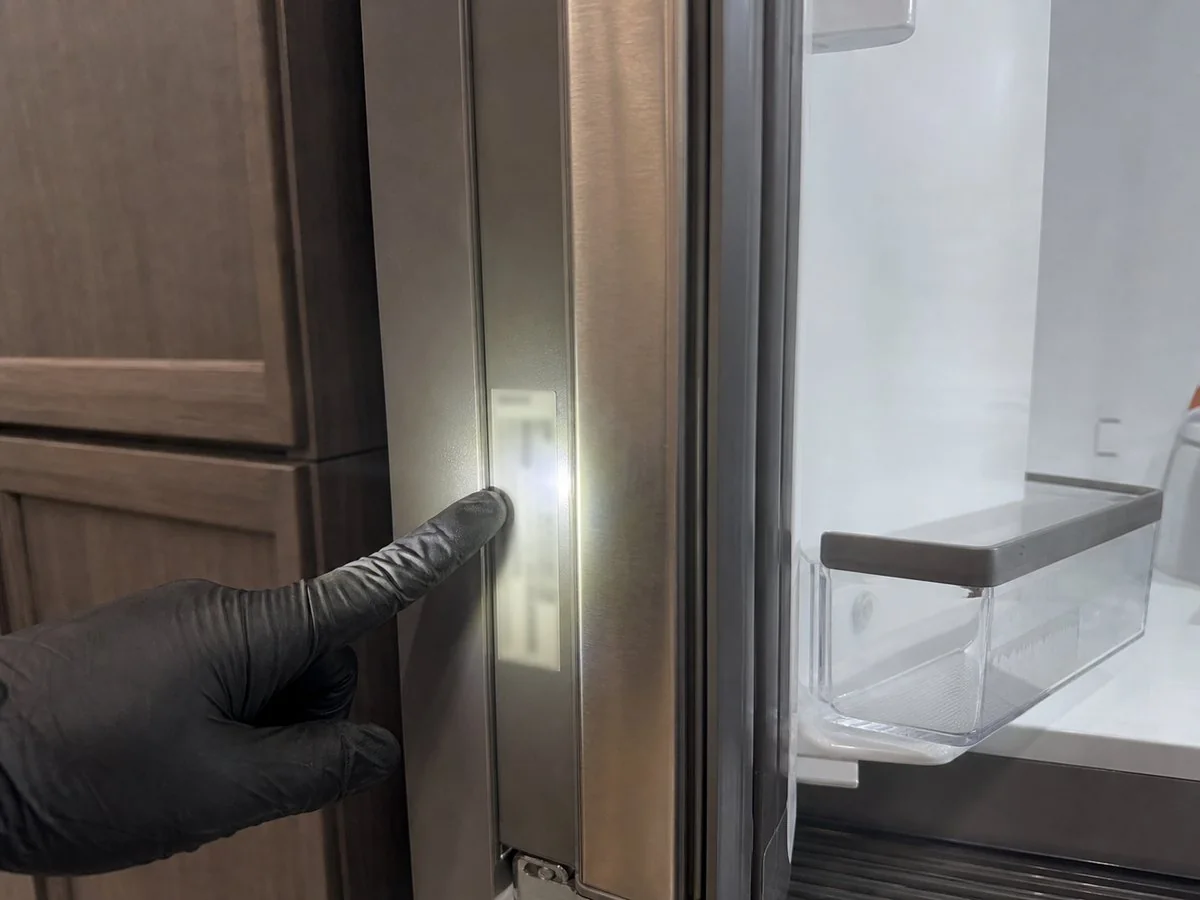
Sub-Zero built a different evaporator fan, defrost thermostat, and damper assembly for each series. A BI-36U and a 648PRO showing the identical symptom may need entirely different OEM parts. The model and serial — typically inside the upper-left wall of the fresh-food compartment — is the first thing we read on site before any diagnosis is written up.
Not sure where to find yours? See the model & serial guide.
Common but overlooked cause
What "condenser coil packed with dust or pet hair" actually means
A Sub-Zero's condenser is a dense grid of metal fins and tubing tucked behind the lower grille, often in tight built-in cabinetry. Its job is to shed heat: refrigerant compressed by the compressor arrives hot, and the condenser releases that heat into room air blown across it by the condenser fan. When dust, pet hair, or debris builds up between the fins, it acts as insulation — the heat can't escape, pressure rises in the sealed system, and the compressor works harder and longer just to hold temperature.
In a Napa summer, when ambient kitchen temperatures can climb well above 80°F, that extra load compounds. The box that just barely kept up in March may start running three or four degrees warm in July — not because anything has broken, but because the condenser is strangled. In a hot kitchen on downtown Napa's tighter footprints where ventilation is already restricted, this happens faster than in open-plan homes.
What diagnosis confirms it: The technician pulls the lower grille, photographs the condenser coil condition, and measures head pressure or notes whether clearing the coil and running the fan returns the box temperature to spec on the visit. That is documented evidence, not a guess.
One limitation
A clogged condenser that has been running overloaded for a long time can stress the compressor over months or years. Cleaning the condenser confirms whether the cooling fault resolves — but it does not tell you whether the compressor has accumulated wear. If the box temperature doesn't recover fully after condenser service, a sealed-system evaluation is the next step. See the sealed system & compressor page for what that involves.
Know your symptom
How the owner notices — and when to stop using the appliance
A Sub-Zero that is not cooling rarely fails all at once. Understanding which section is warm and how quickly it warmed up tells the technician a great deal before they arrive.
Fresh-food section warm, freezer cold
You notice salad wilting faster, drinks not as cold, or a milk jug that feels room-temperature after a day. The freezer still holds ice and frozen food. On a dual-compressor Sub-Zero this pattern is actually reassuring — the freezer circuit is working, which narrows the cause to the fresh-food side's fan, evaporator, or damper rather than a compressor failure.
Normal vs. abnormal: A brief rise after a heavy grocery load is normal; a fresh-food section sitting above 45°F for more than two hours with the door closed is not.
Freezer soft, fresh food still cool
Ice cream is soft, frozen items are losing their firm texture, but the fresh-food section is still in range. On a single-evaporator model, the freezer may be the first casualty when the defrost system fails and ice blocks the evaporator. The fresh-food section can follow within 24 hours.
Normal vs. abnormal: After a long power outage, gradual softening is expected. Softening with the unit running and no power loss means the system is not performing.
Both sections warm
When both compartments are climbing together, the shared element — the condenser, the condenser fan, or the main defrost system — is failing both circuits simultaneously. This is the scenario where a dirty condenser, a dead condenser fan, or a completely iced-over evaporator shows up most clearly. It is also the pattern that eventually points to a sealed-system issue if mechanical causes are ruled out.
When to stop using it and move food
- Move perishables when the fresh-food section is above 45°F for more than two hours.
- Protect a wine cellar: if a Silverado or Coombsville wine column is drifting more than four degrees off set point, move temperature-sensitive bottles to a cool interior space while you wait for service. A single warm day can stress a large collection.
- Do not repack warm food into the appliance after repair — let it recover to operating temperature first.
- Do not unplug and replug repeatedly; this erases the fault pattern the technician uses to confirm the cause.
Ranked diagnosis
Likely causes: simple to expensive — with signs, test and typical repair
This table is ordered the way a technician actually works: eliminate the cheap mechanical causes before considering sealed-system work. For Sub-Zero specifically, the dual-circuit architecture means a one-sided symptom almost never points to the compressor.
| # | Cause | Signs you see | How it's confirmed | Typical repair / Napa range |
|---|---|---|---|---|
| 1 | Door / gasket air leak | Condensation or frost line along the door edge; compressor runs continuously; humidity inside cabinet | Dollar-bill test (gasket grips a bill when closed); temperature probe near the seal; visual frost-line inspection | OEM gasket replacement — $340–$560. No cabinet removal needed. |
| 2 | Dirty condenser coil (dust / pet hair) | Both sections slowly warm; compressor hot to the touch; symptom worse on hot summer days | Grille removal + condenser photo; coil temperature before and after cleaning; box temperature recovery check | Condenser clean + fan check — $150–$225 diagnostic credited. Often resolved same visit. |
| 3 | Evaporator fan failure (fresh-food or freezer side) | One section warm; interior unusually quiet; no airflow felt from vents | Fan motor amp draw; voltage at harness; evaporator cover removal and fan spin test | OEM fan motor replacement — $380–$640. |
| 4 | Frosted evaporator / defrost system fault | One or both sections warm; evaporator panel iced solid; defrost heater or thermostat failed; defrost timer/board stuck | Evaporator panel temperature; visual ice buildup on coil; continuity test on defrost heater and thermostat | Defrost heater, thermostat or control-board defrost circuit — $380–$720. |
| 5 | Stuck or failed damper | Fresh-food section warm; freezer normal or even colder than usual; damper stuck closed | Damper actuator voltage and position test; duct temp difference across the damper | Damper assembly replacement — $340–$580. |
| 6 | Thermistor or control-board fault | Erratic temperatures; display reads normal but actual temps are off; compressor short-cycles | Thermistor resistance vs temperature chart; control-board error codes and input/output voltage checks; model-tag OEM part match | Thermistor — $340–$500; control board — $500–$800. |
| 7 | Sealed system / compressor (EPA-regulated) | Both sections warm after ruling out all mechanical causes; compressor runs but box won't cool; pressure readings abnormal | Manifold gauge pressure readings; compressor amp draw; refrigerant charge verification (EPA-regulated process) | $1,200–$2,900+ — confirmed in writing after readings, never on appearance alone. See sealed system page. |
Ranges are general Napa estimates. Your exact quote depends on the Sub-Zero series, whether the part is current OEM or legacy-sourced, and condenser access in the built-in cabinet. Every repair is confirmed in a written flat quote first. If the diagnosis does land on row 7, the sealed-system bill, explained line by line shows why that row is priced so differently — recovery, refrigerant and the certification carried by the technician doing it.
What we document
The evidence behind every not-cooling quote
A responsible diagnosis of a Sub-Zero that is not cooling generates a paper trail, not an opinion. On every Napa visit the technician records:
- Temperature readings — actual fresh-food, freezer and evaporator temperatures versus the set point. A display that reads "38°F" while the probe says 52°F tells the real story.
- Condenser and evaporator photos — documenting whether the coil is clean or clogged, and whether the evaporator is clear or iced over.
- Door gasket leak check — condensation or frost line location, dollar-bill grip test, door-alignment measurement. A gasket leak that leaves a visible condensation or frost line along the seal is straightforward to document and replace.
- Model-tag proof — the exact model and serial number, read on site, matched to the OEM fan, gasket, control board or defrost part before ordering.
- Component test results — fan motor amp draw, thermistor resistance, damper actuator voltage, defrost-heater continuity — each written up so the quote itemizes what failed and why.
That documentation is what makes a Sub-Zero quote honest: it names the part, its OEM number, and the test result that confirms it — not "we think it might be the board."
Built-in cabinet removal / reseat risk
Sub-Zero built-in refrigerators are integrated into custom cabinetry with panel-ready or flush-inset doors. Pulling the unit forward to reach the condenser, evaporator, or rear components is a precision task: the unit must slide on its cabinet track without racking the frame, and the anti-tip hardware must be re-engaged correctly before the door is re-hung. Done wrong, it can crack a custom panel, shift the door alignment, or void the seal on a freshly replaced gasket.
Before any panel or built-in removal, the technician confirms the cabinet type, toe-kick configuration, and whether the unit is on an adjustable track or hard-mounted — so the reseat goes back exactly as it came out.
OEM parts only
We use OEM-matched parts for every Sub-Zero not-cooling repair — fans, gaskets, defrost heaters, damper assemblies and control boards. On a sealed system that depends on tight refrigerant charge and specific fan curves, a generic substitute can shift the operating conditions and create a new fault within months. The model and serial number, confirmed on site, determines exactly which part ships to your Napa address.
How Napa changes a not-cooling call
Local factors that affect the diagnosis and timing
A not-cooling fault in Napa is not the same job as one in a coastal or inland city. The home type, climate, and hosting calendar change what the technician prioritizes.
Silverado
Large estates with Sub-Zero columns and wine storage. A not-cooling event here often coincides with weekend hosting or a winery dinner deadline — the scheduling pressure is real. Second-home use also means the fault may have been running for days before anyone notices.
Coombsville
Rural and second-home properties that go unmonitored between visits. A condenser that has been overloaded or a gasket slowly losing its seal can progress from mild to severe while the home sits empty. Confirming the box holds temperature before leaving is especially important here.
Downtown Napa
Tighter kitchens in renovated Victorian and craftsman homes often have restricted condenser-grille ventilation. In summer, ambient heat builds up behind the unit faster than in open-plan homes, making a dirty condenser coil fail sooner and harder.
Hot-summer condenser load
Napa's inland summer heat regularly pushes kitchens above 85°F on peak days. A condenser already carrying a partial dust load in March may cross into full failure by July — not because anything "broke" but because the thermal margin disappeared. Scheduling a cleaning before summer is the practical prevention.
Hosting and harvest season timing
A refrigerator that fails three days before a harvest dinner or a long weekend of guests is a priority, not a routine service request. If you are booking from Napa with a hosting deadline, say so — we hold a limited number of same-day and next-morning slots and triage actively when a collection or an event is at risk. Use Book Online directly for the fastest answer on availability.
Not-cooling questions
Six questions Napa owners ask before calling
Why is my Sub-Zero fresh-food section warm but the freezer still cold?
On a dual-compressor Sub-Zero this almost always means one side's refrigeration loop is struggling independently of the other. The most common culprits are a failed evaporator fan on the fresh-food side, a frosted-over evaporator blocking airflow, a stuck damper that has closed off the cold-air path, or a thermistor reading falsely warm and keeping the compressor from running enough cycles. None of those require sealed-system work. The exact cause needs temperature readings and an inspection of the rear evaporator panel to confirm — not a guess from the front.
Both sides of my Sub-Zero are warm — is the compressor gone?
Not necessarily. When both compartments are warm together, the first things to eliminate are a severely clogged condenser coil packed with dust or pet hair, a condenser fan that has stopped, or a defrost system that has completely iced over the evaporator and blocked all airflow to both sections. These mechanical causes are far less expensive than compressor replacement. A sealed-system or compressor failure is an EPA-regulated diagnosis that requires pressure and temperature readings to confirm — we never recommend it on appearance alone. See the sealed system page for what that evaluation involves.
Should I move my food out of a Sub-Zero that has stopped cooling?
Yes, as soon as the fresh-food section climbs above about 45°F for more than two hours. Move perishables to a cooler or another refrigerator. Do not pack warm food back in once the unit is repaired — let the box recover to operating temperature first. If you have a wine collection in a Sub-Zero column that is drifting, move the most temperature-sensitive bottles to a cool interior room while you wait for service. A single warm day in a Silverado or Coombsville cellar can stress a collection that took years to build.
How much does a not-cooling diagnosis and repair cost in Napa?
The diagnostic visit is $150–$225 and is credited toward the repair you approve. Most not-cooling repairs — evaporator fan, defrost heater or thermostat, damper, thermistor, or control board — land between $340 and $950 for parts and labor in Napa. Sealed-system work (compressor or refrigerant repair) runs $1,200–$2,900+ and is only quoted after pressure and temperature readings confirm it is necessary. Every price is fixed in a written flat quote before work starts. Check whether repair makes sense before replacing — a new built-in runs $9,000–$18,000+ installed, and most not-cooling faults are mechanical, not sealed-system.
Why do Napa summers make a dirty condenser show up suddenly?
A condenser can look acceptable in March and fail in July because Napa kitchens often run above 85°F during afternoon heat. Dust, pet hair and cabinet restriction reduce heat rejection. Once that margin disappears, both sections may drift even though no major component failed. Cleaning and fan verification should happen before compressor conclusions.
What temperature reading makes a same-day not-cooling call urgent?
Treat fresh-food readings above 45°F for more than 2 hours as urgent for perishables, and move food out. For freezers, soft ice cream or readings above 15°F mean product quality is already at risk. A wine column above 60°F during a hot Napa day should be called in the same day.
Check whether repair makes sense before replacing
Call (628) 209-6820 or book online to schedule a diagnostic window. The technician verifies model, serial, temperatures and repair evidence at the appliance before the written quote.
Is it the fridge or the freezer? If the freezer side won't get cold instead, that's a different repair. Sibling symptoms: loud or buzzing · leaking water.
More guides: Home · Sub-Zero Repair overview · Sealed System & Compressor · Call / Book
Local reviews
Not-cooling reviews with temperatures, neighborhoods and repair branch
4.9/5 network rating372 verified repairs
“Both sections drifted after the house sat empty for 5 days: 46°F fresh food and 21°F freezer. The condenser was packed with vineyard dust, but the compressor amperage was normal. Cleaning and fan verification stayed inside the $215 diagnostic, and temperatures recovered overnight.”
“A frost line on the hinge side made our 650 look like a cooling failure. The tech used a dollar-bill test, showed the gasket gap, and installed the serial-matched seal. The $480 gasket repair took under 2 hours and the fresh-food section was back to 38°F.”
Service desk: 1300 First Street, Suite 368, Napa, CA 94559. Visits are scheduled by appointment; call before stopping by.