
“Our display showed a temperature alarm after a power blip, and intake told us not to clear it again. The technician found fresh food at 44°F, freezer at 2°F, and a failing refrigerator thermistor. The $430 sensor repair took 90 minutes and stopped the repeat alarm.”
4.9/5 network rating372 verified repairs
Napa · Technical reference
Sub-Zero Error Codes & Alarms in Napa — reading them safely
How do I read a Sub-Zero error code or alarm in Napa?
Photograph the display before clearing it, then note the model and serial from the upper-left interior wall, because Napa Sub-Zero Repair reads alarm meaning by series and thermistor or board behavior, not a generic number. Across Alta Heights kitchens in 94559 we confirm on site; phone (628) 209-6820 to preserve the code first.
Sub-Zero error codes are read by model and serial, not a generic chart — the same display means different things across model families. Photograph the panel before clearing it, then note the tag inside the upper-left wall. In Browns Valley second homes a flashing "Service" indicator, "Vacuum Condenser" reminder or door-ajar beep each point somewhere different; book online with the model number to confirm.
On this page
Before you book: find these three things
The alarm code meaning is model-specific. A code that means "sensor open" on one series means something different on another. The two things that let us confirm the right interpretation:
1. Model number — reads like BI-36U, 648PRO, 736TCI, 424, or IC-27. Tag is usually inside the upper-left interior wall.
2. Serial number — 7–8 digits on the same tag, e.g., 0234567. The serial range determines which generation of control board and which code set applies.
3. Photograph the display alarm before you clear it. Many codes are erased the moment you press "OK."
Not sure where the tag is? See the model & serial guide for tag locations across refrigerator, column and wine models.
The list owners ask for
Sub-Zero error codes & alarms list (Napa)
Sub-Zero rarely uses bare numeric codes — most current panels show plain-language alarms, and meaning is confirmed by model and serial, never a generic chart. The list below names only real Sub-Zero behaviors; where the meaning is not universal, verify by model/serial before acting.
| Alarm / display behavior | What it usually points to | What to do |
|---|---|---|
| Flashing or solid "Service" indicator | A stored fault the board logged — a sensor, defrost or control event, not always a failure | Photograph it before clearing, read the model and serial off the upper-left tag, and verify which subsystem the indicator maps to before assuming a part |
| "Vacuum Condenser" reminder, or compressor running far longer than normal | Condenser coil packed with valley dust and summer wildfire ash — a maintenance alert, not a component failure | Pull the lower grille, clean the coil, confirm the condenser fan spins, then re-probe; in Napa's hot, ashy summers this is a real interval, not a formality |
| Door-ajar / over-temp alarm after the door was opened or loaded | Gasket not fully sealing, a dropped hinge, an obstruction, or the door switch — common on second homes left unwatched in Browns Valley | Close firmly, run a dollar-bill drag test around the seal, wait five minutes; if it clears and temperature holds, monitor — if it recurs, the seal or hinge needs inspection |
| Fresh-food side warm while the freezer still holds (high-temp alarm on the fridge side) | Refrigerator-side evaporator fan, a frosted evaporator coil, or a stuck damper — not the sealed system | This cannot be read from the panel; a technician pulls the rear access, reads the evaporator surface temperature and checks the fan and damper |
| Blank, frozen or unresponsive display | Main or interface board, a ribbon/harness connector, or the power supply to the board | Verify incoming power and reseat connectors first; a surge can lock the board until a controlled power cycle — confirm before ordering an expensive board |
| Newer EC-style alphanumeric alarms on recent panels | Generation-specific messages whose meaning is not universal across series | Do not apply an internet code chart for a different model; verify the message against your exact model and serial range |
No bare numeric "fault numbers" are listed here on purpose — Sub-Zero meaning is model-specific. Book online with your model and serial number, or call (628) 209-6820, and we confirm which interpretation applies to your unit.
When the alarm first fires
Four steps before touching anything
The order matters. Clearing an alarm before noting its state destroys the diagnostic information the control board was storing.
1
Photograph the display — do not clear yet
Most current Sub-Zero panels show a text description ("High Temperature," "Door Ajar," "Ice Maker Fault," "Service Condenser") rather than a bare number. Older units may show a numeric code. Either way, photograph it first. Once you acknowledge the alarm the code may not reappear even if the fault persists.
2
Note what was happening when the alarm started
Power blip? Door left open for loading groceries? Hot afternoon in an Alta Heights kitchen with west-facing exposure? First time ever, or repeated? This context is the single most useful thing you can give a technician — it narrows a two-hour diagnosis to twenty minutes.
3
Check the door seal and door position
A door-ajar alarm is often genuine — a gasket that has not fully closed, a shelf blocking the door, or a hinge that has dropped. Close the door firmly, wait five minutes, and check whether the alarm clears on its own. If it does and temperature is holding, no service visit is needed. If it fires again, the seal or hinge needs inspection.
4
Read the actual temperature — not just the setpoint
The front display shows the setpoint, not necessarily the actual cabinet temperature. Place a calibrated thermometer inside and let it stabilize for 20 minutes. If the actual reading matches the setpoint and stays there, a transient event (power blip, door left open) may have triggered the alarm. If it is still elevated, refrigeration is the problem.
5
Then — and only then — acknowledge the alarm
Press the alarm button or follow your model's procedure to silence the beep. Watch for 2–4 hours. If the same alarm returns, call with the photo you took in step 1 and the model number ready.
A common and misread alarm pattern
Fresh-food section warm while the freezer still holds
This is one of the most frequently misread alarm situations in Sub-Zero service. The owner sees a high-temp alarm on the refrigerator side, notes that the freezer is still cold, and concludes the compressor must be failing. On most current Sub-Zero models that logic does not apply, and acting on it leads to unnecessary expense.
Sub-Zero's dual-compressor and dual-evaporator architecture means the fresh-food circuit and the freezer circuit are largely independent. A warm fresh-food compartment with a working freezer is a refrigerator-side problem — almost always the evaporator fan on that side, a thermistor reading wrong, a frosted evaporator coil that has not completed a defrost cycle, or a stuck damper that is not letting cold air move. None of those is a sealed-system failure.
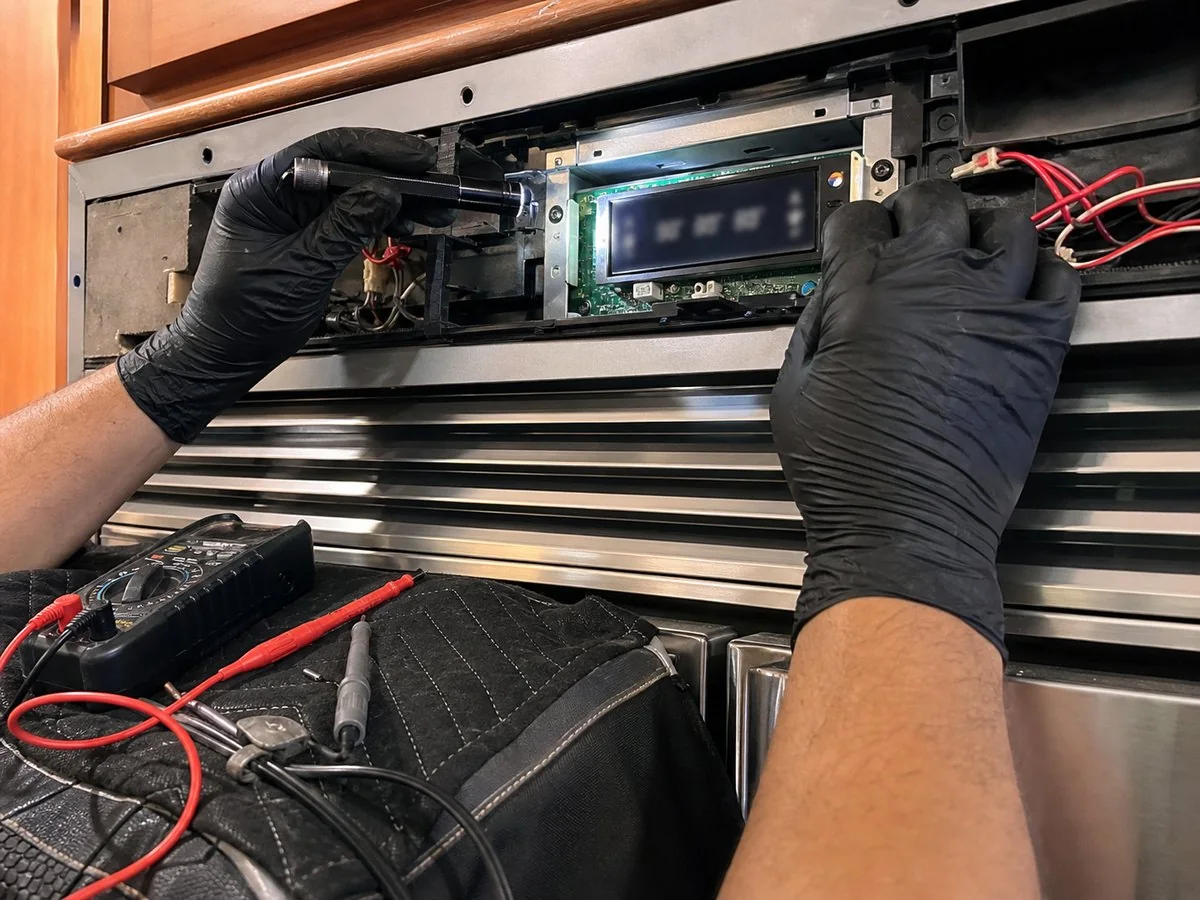
What diagnosis confirms it: a technician pulls the rear or lower access panel, reads the evaporator surface temperature with a probe, checks whether the fan is spinning, and verifies the thermistor resistance with a meter. A frosted evaporator will be visually obvious and can be confirmed with a temperature differential test. A faulty fan reads differently from a failed thermistor — and they are different parts at different prices.
One limitation: the confirmation test cannot be done from the front panel. The evaporator is not accessible without disassembly, and the thermistor resistance reading requires a meter on the actual component. "The freezer is cold so the compressor is fine" is a reasonable inference — but knowing which refrigerator-side component failed requires getting inside the unit. That is the diagnostic visit.
Safety boundary
What an owner can safely check — and where to stop
Stop here for refrigerant, electrical and control-board work
Refrigerant systems are sealed and EPA-regulated. Opening a refrigerant line, adding refrigerant, or checking system pressure requires EPA Section 608 certification and recovery equipment. Never attempt this yourself. Similarly, control-board replacement involves live 120 V wiring and discharge capacitors — even with the unit unplugged, residual voltage can be present. Ice-maker water valves are connected to both plumbing and line voltage. These are technician-only operations. The list below covers the boundary clearly.
Safe for an owner to check
- Photograph the alarm code before clearing it
- Check that all doors close fully and the magnetic seal makes contact around the full perimeter
- Place a thermometer inside and read actual temperature (not just the setpoint display)
- Inspect the lower grille area for obvious dust buildup — a vacuum at the grille opening is safe
- Check whether ice maker is switched on and the water supply valve behind the unit is open
- Note whether an alarm appeared after a power outage and whether it recurs after clearing
- Confirm the door hinge closes the door all the way when released from 90 degrees
Technician-only: do not attempt
- Thermistor resistance testing (requires panel removal and live-circuit access)
- Evaporator access for defrost verification or ice-bridge clearing
- Control board diagnostics, replacement or wiring inspection
- Refrigerant pressure testing, leak tracing or recharging (EPA-regulated)
- Compressor run tests or sealed-system verification
- Ice-maker inlet valve testing or water line disassembly
- Any work requiring the unit to be eased forward out of a built-in cabinet opening
Alarm reference
Sub-Zero alarm types — diagnostic table
This table describes alarm behavior in plain terms. Code numbers and exact temperature thresholds vary by model and serial range — the table does not invent specific values. Use the "Confirmation test" column as the technician's starting point, not a DIY procedure.
| Symptom / Alarm | Possible component | Confirmation test | False-positive to avoid | Repair path |
|---|---|---|---|---|
| Door-ajar alarm — continuous or intermittent beep with door indicator lit | Door gasket, door hinge, obstructed closure, door-ajar switch | Close door firmly; check full-perimeter magnetic seal contact with a dollar-bill drag test; inspect hinge drop | Shelf or bottle slightly blocking door from closing all the way — clear obstruction first before calling | Gasket replacement (owner-verifiable defect); hinge adjustment; door-switch test by technician if gasket and hinge are good. See door gasket guide |
| High-temperature / temperature-excursion alarm — fresh-food side above setpoint | Evaporator fan (refrigerator side), frosted evaporator coil, stuck damper, thermistor out of range | Read actual internal temperature with calibrated probe; verify fan is audible running; technician checks evaporator surface temperature and damper position | Door held open for grocery loading, power blip, or ambient kitchen heat spike — clear alarm and monitor for 2–4 hours before calling if temperature recovers | Fan replacement, defrost-cycle forced test, damper actuator, or thermistor replacement — confirmed by technician meter readings, not display code alone |
| High-temperature / temperature-excursion alarm — freezer side above setpoint | Freezer-side evaporator fan, freezer thermistor, defrost heater, freezer compressor (on older single-compressor models) | Verify freezer fan is running; check for ice accumulation at rear panel; technician reads freezer evaporator temperature and defrost heater continuity | Heavy frost accumulation from door left ajar for an extended period — a forced defrost cycle may resolve it temporarily; if alarm recurs, the defrost system needs testing | Defrost heater, thermostat or control replacement; fan motor; sealed-system work only if compressor confirmed failed. See sealed-system guide |
| Vacuum condenser / Service Condenser reminder — scheduled maintenance alert | Condenser coil and fan area (not a component failure — a service reminder) | Inspect lower grille area; if coil is visibly packed with dust or pet hair, professional cleaning is the correct response — not clearing the alert and ignoring it | This is a maintenance reminder, not a fault code — do not assume the refrigerator is failing; but do not ignore it in a Napa summer, where a dirty condenser raises head pressure and shortens compressor life | Professional condenser clean; technician verifies fan operation at the same visit. Napa heat makes this a meaningful interval, not a formality |
| Sensor open or sensor short — display shows fault related to temperature sensor | NTC thermistor (fresh-food, freezer or evaporator), wiring harness, control board input | Technician disconnects thermistor and reads resistance: open-circuit (OL) or near-zero (shorted) confirms sensor failure; mid-range reading points to harness or board input — verify by model/serial | A loose connector mimics a sensor open; a technician reseats connectors before condemning the thermistor — a wiring check is the first step, not immediate part replacement | OEM thermistor matched to model and serial; harness repair if connector is the cause; control-board input test if sensor and harness check out |
| Control board no-comms / communication fault — display shows error or goes blank, unit unresponsive | Main control board, user-interface board, wiring between boards | Technician tests power supply to board, inspects ribbon and harness connections, reads board status via service mode if accessible — verify procedure by model/serial | A power surge can lock the board in a fault state that clears after a controlled power cycle — confirm with technician before ordering a board, which is an expensive part | Board replacement with OEM part matched to model and serial; power-cycle procedure varies by series — do not hold power buttons in random combinations without guidance |
| Ice-maker fault / ice maker alarm — display indicates ice-maker error or no ice production | Ice-maker module, inlet water valve, fill tube (frozen), ice-maker thermistor, bin-full arm or sensor | Verify water supply and filter are not blocked; technician checks inlet valve voltage and flow, probes ice-maker module harness, reads thermistor resistance, inspects fill tube for frost | A slow ice maker producing hollow cubes or small batches often means a partially blocked filter or a slightly low freezer temperature — not an ice-maker module failure; confirm with temperature reading first | Filter replacement (owner); inlet valve replacement, fill-tube defrost, module replacement — matched to unit. See ice maker guide |
| Dual-zone wine cabinet alarm — one zone off temperature while other holds | Zone-specific thermistor, zone damper or fan, control board zone output, door seal on wine column door | Technician reads actual zone temperatures (not display setpoint), checks zone fan operation, inspects door gasket for the affected zone, reads thermistor resistance | A wine column near a west-facing Silverado-area window may show temperature excursion on hot afternoons even with perfect hardware — verify ambient temperature contribution before attributing fault to a component | Zone thermistor or damper repair; door-gasket replacement on wine column; shading or airflow improvement for ambient-heat-driven excursions |
Alarm codes, exact temperature thresholds and service procedures are model-specific. Use the online booking with your Sub-Zero model and serial number to confirm which interpretation applies to your unit.
Series-specific behavior
Model-family notes — what to verify by series
Sub-Zero's alarm behavior, code display format, and service-mode access differ meaningfully by product family. These notes flag what to verify — not specific code numbers, which must be confirmed by model and serial.
Classic / BI Series
BI-36, BI-42, BI-48, BI-30
Classic built-in column-over-drawer and side-by-side refrigerators. Alarm display format and code set changed across production years — the serial range determines which generation of control board is installed. Verify: whether your unit has a single or dual condenser fan arrangement, and whether the evaporator fans are accessible from the rear or require door removal. The condenser location (top rear) matters for Alta Heights hillside kitchens with restricted ventilation above the unit.
Designer Series
736TCI, 736TFI and related panel-ready
Panel-ready integrated units with a different control interface from the Classic series. Alarm messages on these units often appear in a text-based display format rather than numeric codes. Verify: panel door alignment is a common alarm trigger on Designer units — a panel-ready door that has shifted can defeat the magnetic closure and generate persistent door-ajar alarms. Check hinge and panel adjustment before attributing an alarm to a sensor.
PRO Series
PRO 48, PRO 36
Largest built-in configurations with dual compressors and typically dual evaporator fans. Alarm behavior on PRO units separates fresh-food and freezer sections clearly on the display. Verify: which compressor the alarm is associated with — PRO units with independent sealed circuits can have one side alarm while the other runs normally, and the service mode (verify access procedure by serial) distinguishes which circuit is reporting. Condenser access on PRO units requires specific clearance in front of the lower grille.
Integrated Series
IC-27, IT-24, ID-30 and column formats
Fully integrated refrigerator and freezer columns designed to disappear behind cabinetry. Easing an Integrated unit forward for service in a Browns Valley built-in kitchen requires planned access — cabinet trim and floor protection often need attention before the unit can be pulled. Verify: on Integrated columns, the model number location may be behind a drawer or on the unit frame rather than inside the door liner — photograph before the unit is in service position.
Wine Column / Storage
SW-24, SWCP30, UC-24W and dual-zone
Wine-specific storage with tight temperature tolerances. Alarm sensitivity is higher than a food refrigerator by design — a few degrees of excursion that a food fridge might not alarm on can trigger a wine unit alarm. Verify: dual-zone wine units have independent thermistors and dampers per zone; an alarm on one zone does not mean both zones have failed. In Silverado-area homes with large collections, temperature-excursion alarms during summer afternoons may reflect ambient heat load rather than a component fault.
Older 600 Series
590, 601, 611, 650 and legacy built-ins
Units produced before the current generation of display panels may show numeric alarm codes rather than text descriptions. Code meaning in the 600 series is not transferable to current-generation models — the same number can mean different things across production years. Verify: alarm interpretation for 600-series units requires the specific model number and, in some cases, the production year from the serial decoder. Do not apply internet code lists for current models to a 600-series unit. Call or book online; the technician verifies model and serial on-site for an accurate read.
What a diagnosis actually documents
Evidence, photos and confirmed findings
A Sub-Zero alarm diagnosis is not complete until there is physical evidence for the finding. These diagrams represent the three documentation points a technician uses on a Napa visit — so a quote is backed by data, not a guess.
What "confirmed" means on a Napa service request
A complete alarm diagnosis for a Napa Sub-Zero produces four pieces of documented evidence before a quote is issued: actual temperature readings from a calibrated probe (not just what the display says), condenser and evaporator photos showing the physical state of each heat exchanger, model-tag proof confirming the exact model and serial so the OEM part ordered is the correct one, and component evidence — a meter reading, a fan RPM check, or a visual of a failed gasket or OEM fan with the part number visible. If an ice maker is slow, jammed, or producing hollow cubes, temperature readings at the ice-maker thermistor and inlet valve testing are part of that same documentation set. We do not issue a repair quote based on a symptom description alone.
How Napa changes the alarm picture
Local factors that make a Sub-Zero alarm mean something different here
An alarm that reads "temperature excursion" in a San Francisco kitchen and the same alarm in a Napa kitchen can have different root causes. The local climate and home type change what a technician looks at first.
Alta Heights
Hillside homes with west-facing kitchens absorb afternoon heat from May through October. A temperature-excursion alarm that fires at 3 p.m. on a 95-degree Napa day but clears by evening may trace to condenser overload in a confined built-in cabinet — not a sensor fault. Airflow around the grille is the first check in Alta Heights.
Browns Valley
Second-home and remodeled-ranch properties often sit unwatched for days or weeks. A temperature-excursion alarm that has been running since the owners were last in residence may mean the food was lost hours ago — and a wine column that alarmed and was never addressed could mean a collection at risk. We prioritize these calls when a hosting deadline or second-home schedule is involved.
Silverado
Larger estates in the Silverado area frequently have wine-column configurations alongside food refrigeration. A dual-zone wine alarm here is treated differently from a household alarm — collection value and the tight temperature tolerance of wine storage means a same-day investigation is usually the right move rather than monitoring for another cycle.
Downtown Napa / Oxbow area
Older homes near downtown may have legacy Sub-Zero 600-series units installed in cabinetry that has not been modified since the original installation. These units generate numeric alarm codes that require serial-number decoding, not the text-based alarms of current models. Call or book online; the technician verifies model and serial because diagnostics differ by generation.
Questions about Sub-Zero alarms
Six Sub-Zero alarm questions Napa owners ask before clearing a code
What does a Sub-Zero temperature-excursion alarm mean?
A temperature-excursion alarm fires when the box has been above its setpoint long enough for the control board to flag it — typically after a door left open, a power blip, or a real refrigeration problem. If clearing the alarm and verifying the door seal keeps the reading normal, it may have been a transient event. If the alarm returns within a few hours, something in the refrigeration circuit — fan, thermistor, damper or evaporator — needs testing. The exact threshold varies by model and series; verify with the model number before assuming the cause.
My fresh-food section is warm but the freezer is still holding — is that an alarm or a real failure?
That pattern is almost always accompanied by a high-temp alarm on the fresh-food side, and on a dual-compressor Sub-Zero it usually points to the refrigerator-side evaporator fan, a frosted evaporator coil, a stuck damper, or a thermistor reading wrong — not a failed compressor. Confirming which component is at fault requires pulling the back panel and reading actual temperatures; it cannot be determined from the alarm code alone. Read the full explanation in the not-cooling diagnostic guide.
Can I clear a Sub-Zero alarm myself?
Acknowledging an alarm on the display is safe — it silences the beep and clears the indicator. What you should not do is clear it and assume the problem is gone. Write down the exact code or message and what was happening when it appeared, then watch whether it returns. If the same alarm fires again within a few hours, that is confirmation you need a diagnosis, not another reset. Photograph the display before pressing any button.
Why does my Sub-Zero alarm after a power outage in Napa?
After a power interruption the control board may log a temperature-excursion event and sound the alarm on restart if the box warmed above its threshold during the outage. This is normal behavior and a single post-outage alarm that clears and does not return is not a service request. Repeated alarms after restoration, or an alarm combined with ongoing warm temperatures, indicate a component that was already borderline before the outage and should be tested. Napa's summer heat means boxes that were already running warm before the outage are more vulnerable during a power event.
How do I read a Sub-Zero alarm code without the manual?
Most current Sub-Zero units display alarm messages in plain text — phrases like "High Temperature," "Door Ajar," "Service Condenser" or "Ice Maker Fault" rather than bare numeric codes. Older units (including some 600-series models) may show numeric codes whose meaning varies by model and serial range. The safest step is to photograph the display, note the model number from the tag inside the upper-left wall, and use Book Online — the model number tells us which generation's code set applies. Do not apply a code list you find online for a different Sub-Zero model.
When is a Sub-Zero alarm urgent instead of something to monitor?
It is urgent when the fresh-food section is above 45°F for more than 2 hours, the freezer is above 15°F with soft food, or a wine zone is above 60°F during warm Napa weather. A door left open briefly can be monitored; a recurring alarm with measured temperature drift needs service.
Call or book online ? we'll diagnose what the alarm means for your unit
Call (628) 209-6820 or book online to schedule a diagnostic window. The technician verifies model, serial, temperatures and repair evidence at the appliance before the written quote.
Diagnostic visit $150–$225, credited toward the repair. Written flat quote before any work begins. OEM parts matched to model and serial. Mon–Sat, 7 am–7 pm.
Local reviews
Alarm-code reviews with preserved code evidence and measured result
4.9/5 network rating372 verified repairs
“A door-ajar alarm kept returning even when the door looked closed. Service tested the gasket, hinge drop and switch instead of replacing the display board. The hinge adjustment and gasket correction were finished in 2 hours, and the alarm stayed quiet through a 24-hour check.”
“The vacuum-condenser reminder appeared before a hot weekend, and the lower grille was packed with dust. They cleaned the coil, verified condenser-fan operation, and logged normal amperage. The $195 maintenance visit prevented a temperature alarm that would have looked like a larger failure.”
Service desk: 1300 First Street, Suite 368, Napa, CA 94559. Visits are scheduled by appointment; call before stopping by.