
“Our BI-48 sat inside custom millwork with a tight island clearance. The technician protected the hardwood, pulled the unit 28 inches, cleaned the condenser, replaced a noisy condenser fan, and reseated the panel flush. The $760 repair took 3 hours without scuffing the cabinet face.”
4.9/5 network rating372 verified repairs
Cabinet-Safe Built-In Service · Napa
Cabinet-Safe Built-In Sub-Zero Service in Napa
If your built-in Sub-Zero in a Napa kitchen is running warm, showing condensation at the door or alarming, the most common culprit is a condenser coil packed with dust or pet hair — a problem that gets worse in Napa's summer heat and goes unnoticed in second-home kitchens between visits. For the wine-country estates up-valley, the added challenge is that every service request involves custom cabinetry and panel-ready doors that must be protected throughout. Call or use Book Online — we pull, service and reseat built-ins without leaving a mark on your millwork.
Second-home scheduling, harvest-season hosting deadlines and the custom millwork common across Napa's wine-country estates make built-in Sub-Zero service a different job than servicing a freestanding unit. We factor that into every visit.
Model & serial ? verified before parts are quoted
Sub-Zero built-in models read like BI-36U, BI-48SD, 648PRO or 700TFI, with a serial such as 02345678. The serial range determines which OEM gasket profile, fan motor and control board fits your unit — so we confirm it before the truck rolls.
The tag is usually inside the upper-left interior wall or behind the lower grille. The technician verifies it on-site before parts are quoted or installed.
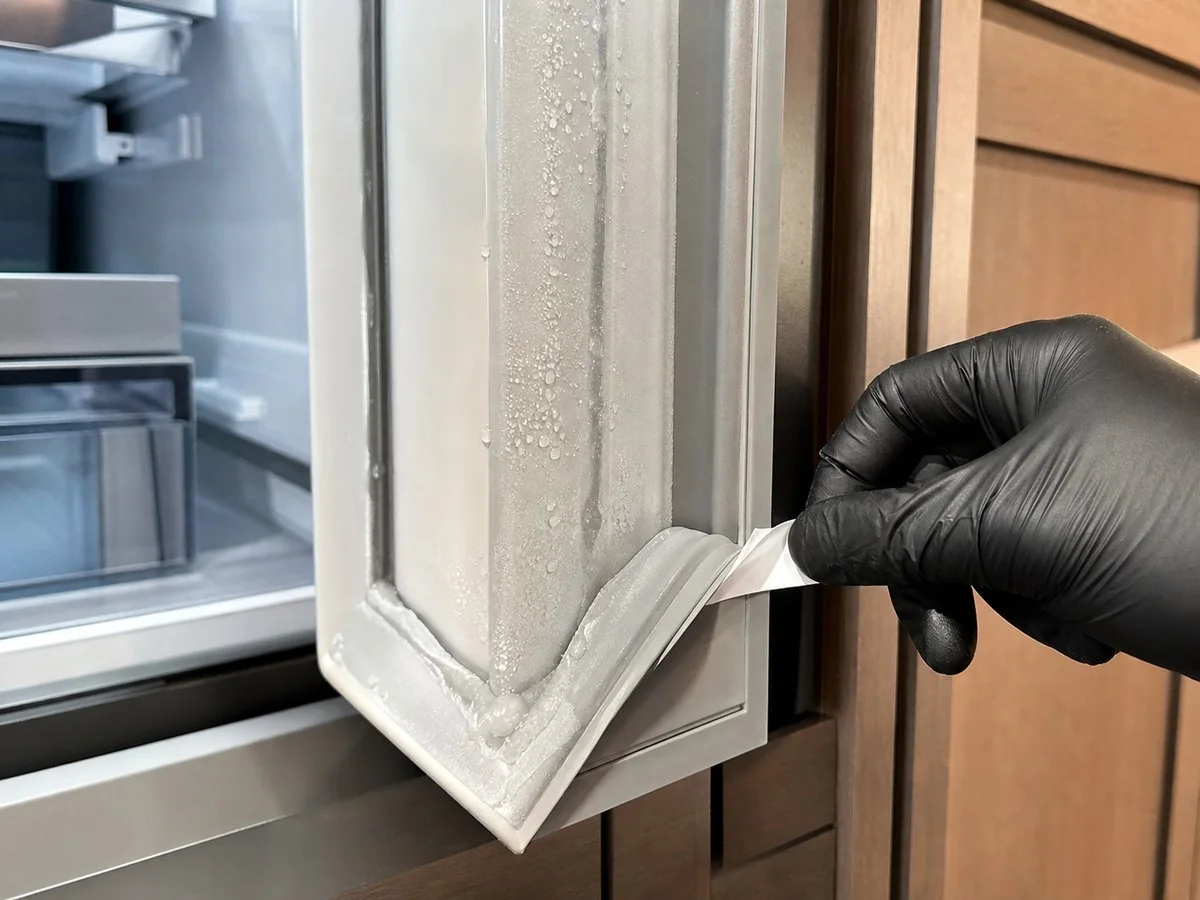
Symptoms that point to the door seal
Door gasket leak, condensation and frost lines — what each one means
On a Sub-Zero built-in, the door seal does more than keep warm air out. It maintains the differential that protects both the fresh-food section and, on dual-compressor models, a fully independent freezer circuit. A failed gasket shows up in three ways — and they are not all the same fault.
Condensation on the door face or frame
When moist kitchen air meets a cold surface through a failing seal, it condenses on the exterior of the door or on the cabinet surround. In a Napa kitchen with a panel-ready door, this moisture can reach the custom millwork and cause swelling or finish damage before the refrigerator problem is even noticed. The first place to check is whether the gasket is pulling away from its channel, has gone hard, or is no longer making contact around all four edges when the door is closed.
Frost line at the door hinge or corner
A thin frost line that appears at the same spot every time — typically a hinge corner or the gasket seam — is a sign the seal is leaking air at that specific point. On a built-in, hinges can drift as the unit settles or after a leveling shift, opening a micro-gap that allows warm-humid air in and causes localized frost. This is different from a gasket that has failed uniformly across its length: a hinge drift is a geometry problem, and fixing only the gasket without re-leveling and verifying door alignment will not hold.
What diagnosis confirms — and one limitation
Diagnosis of a gasket fault involves pressing a single sheet of paper between the gasket and the door frame at multiple points and pulling it out: resistance all the way around confirms a good seal; easy slip-out identifies the leak zone. We also read the actual interior temperature of both sections and check whether the evaporator is accumulating excess frost from the air infiltration. The limitation: if the unit has already been running with a bad gasket for months, the evaporator may have built up a frost block that masks the true performance baseline — we note that in the quote so you know what the second visit confirms.
Sealed-system suspicion
A box that is still cold but not as cold as it should be, with no obvious gasket leak and a clean condenser, is one that raises sealed-system suspicion. We do not diagnose a refrigerant issue from the symptoms alone — that needs EPA-regulated verification: actual temperature delta readings across the evaporator and condenser, visual evidence of the evaporator pattern, and confirmation that mechanical causes (fan, damper, thermistor) have been ruled out. We document all of that before any sealed-system quote is written.
Adjacent page
For a full gasket replacement walkthrough, including how magnetic profiles are matched by model series and why a generic gasket can misalign a panel-ready door, see the door gasket & seal repair guide.
The technical procedure
How a built-in Sub-Zero is pulled and reseated safely — for Napa custom millwork
Pulling a built-in is not the same as sliding out a freestanding unit. The cabinetry is load-bearing, the flooring is often hardwood or stone tile, and the panel-ready overlay has its own alignment that must be re-confirmed after the unit returns to its opening. Here is the exact sequence we follow.
1
Protect the floor and millwork
Before anything moves, we lay floor protection across the pull path — hardwood and stone tile are both at risk from the unit's feet if the rollers are not engaged correctly. The cabinet face frame and any adjacent cabinetry gets covered. On Yountville estate kitchens and St. Helena homes with custom inset cabinetry, this step can take longer than the condenser service itself.
2
Disconnect the water line and power
Water supply to the ice maker is shut off and the line drained before the unit moves. Power is disconnected at the outlet or breaker — not just switched off at the unit. We do not rush this step: a water leak behind a built-in in a custom kitchen is a cabinetry problem, not just a repair inconvenience.
3
Ease the unit forward on its rollers
Sub-Zero built-ins have leveling legs and rollers designed for service pulls. We engage the rollers properly and ease the unit straight out — not rocked or tilted — to avoid stressing the hinge assembly or flexing the cabinet surround. The grille trim piece is removed first and set aside, not forced.
4
Access the condenser, back panel and evaporator
With the unit clear of the opening, the condenser coil is inspected and cleaned — this is where dust or pet hair packed into the fins is found and removed. The back panel access for evaporator, fan and sealed-system components is also now reachable. We take condenser and evaporator photos as part of the visit record.
5
Reseat, re-level and verify door alignment
The unit is pushed back into its opening square, then re-leveled with the adjustment legs to the manufacturer's specification. Level is not optional: a built-in that sits even slightly off will develop recurring door-seal problems and, on heavy panel-ready overlays, premature hinge wear. We confirm the bubble level before moving to door alignment.
6
Confirm door and panel alignment, reconnect, verify temperatures
The panel-ready door is checked for gap consistency top-to-bottom and flush-to-cabinet-face. The grille trim is refitted. Water and power are reconnected and the unit is brought to temperature before we leave — we read the actual temperature before closing up, not an estimated pull-down time. The invoice records the before-and-after readings.
Napa-specific note
Up-valley homes in Yountville often have narrower service corridors between the island and the unit, which affects how far the unit can be pulled before the water line runs taut. We ask about the kitchen layout during intake so we arrive with the right extension fittings and floor protection width. St. Helena properties with older custom cabinetry sometimes have non-standard opening depths — we confirm before pulling that the unit can fully clear the cabinet face.
What you get in writing
OEM parts, invoice documentation and honest warranty terms
The warranty terms, the parts policy and the invoice contents are ours to define honestly — not a franchise promise we cannot actually back up. Here is exactly what we commit to and what we do not.
| Item | What it means in practice | Limitation / honest qualifier |
|---|---|---|
| OEM parts policy | Every replacement component is an OEM part matched to your model number and serial range. We confirm the part number against the model tag before ordering so the correct version of a gasket, board or fan arrives for your specific unit. | If a part is on manufacturer back-order, we tell you before the visit and discuss options. We do not substitute an aftermarket part without explicit discussion. |
| Invoice documentation | The written invoice records: model and serial confirmed on-site, the fault diagnosed and by what evidence (temperature readings, meter readings, gasket test, condenser/evaporator photos), the OEM part number installed, and the temperature or alignment readings taken after repair. | The invoice is your record of the repair — it cannot be used as a manufacturer's warranty document. |
| Workmanship guarantee | We stand behind the repair we performed. If the same fault recurs within the guarantee period due to our workmanship or the OEM part we installed, we return and address it at no additional charge. | The guarantee covers the repair performed — not subsequent unrelated faults on a separate system. Ask for the specific guarantee period on your repair when you approve the quote. |
| Parts guarantee | OEM components carry the manufacturer's component warranty, which varies by part type. We document the part number so that warranty claim can be made if applicable. | Component warranty claims go through Sub-Zero Group, Inc. — we assist with documentation but cannot process a factory claim on their behalf. |
| What we are not | We do not claim factory certification or a factory warranty extension. | If factory-authorized service is required by your home warranty or insurance carrier, ask your carrier for their approved provider list. We will tell you honestly if that applies to your situation. |
| Service / symptom | What is included | Price range | Typical timing |
|---|---|---|---|
| Cabinet-safe diagnostic | Floor protection, model/serial verification, temperature readings and access plan | $150-$225 | Same visit, credited to approved repair |
| Gasket, hinge or panel alignment | Door swing check, magnetic seal test, overlay-panel adjustment and OEM gasket if needed | $425-$760 | 90 minutes to 3 hours |
| Fan or condenser-access repair | Controlled pull, condenser cleaning, fan test and serial-matched fan replacement | $540-$940 | 2-4 hours when part is stocked |
| Control or thermistor branch | Board output, thermistor resistance, wiring checks and OEM part matched by serial | $675-$1,250 | Same day to 4 days if ordered |
| Sealed-system suspicion after access | EPA-regulated pressure evidence after airflow and electrical causes are ruled out | $1,250-$2,900+ | Quoted separately after proof |
Final cabinet-safe pricing depends on water-line slack, cabinet clearance, panel weight, serial-matched part availability and whether one access problem caused a second cooling fault.
OEM components by category
Five Sub-Zero part categories — and why serial matching matters for every one
Sub-Zero built-in units are not a single product line. The BI-36, BI-48, 600 series, 700 series and PRO-handle units differ in evaporator configuration, board architecture and hinge geometry. A part that looks identical on a photo may be wrong for your serial range — and on a built-in, an incorrect gasket will misalign a panel-ready door the day it is installed.
Evaporator and condenser fans
Both the evaporator fan (inside the unit, circulating cooled air) and the condenser fan (at the back or top, cooling the refrigerant loop) are model-specific in blade profile, shaft diameter and speed rating. A condenser fan that runs slower than spec raises head pressure and makes the box run warm — the same symptom as a condenser coil packed with dust or pet hair, but a different repair entirely. We confirm which is at fault with meter readings before ordering either.
Door gaskets
Sub-Zero gaskets use a magnetic strip profile that varies by door width, door height and the generation of the unit. A gasket from the wrong series may appear to fit but will not compress correctly against the face frame, leaving a micro-gap that causes the condensation and frost line pattern described above. Serial matching eliminates this. On panel-ready doors, an incorrect gasket can also shift the door geometry and affect overlay alignment.
Control boards and thermistors
The control board manages both compressor circuits, the defrost cycles, alarm thresholds and ice-maker timing. Sub-Zero has released revised board versions that are backward-compatible only within serial ranges — installing the wrong generation can introduce new alarm codes or disable a feature. Thermistors (temperature sensors) are equally serial-range specific; a thermistor reading slightly off will cause the control board to misjudge when to run the compressor, producing the gradual temperature drift that looks like a gasket or sealed-system issue before it is properly diagnosed.
Ice-maker modules
The ice-maker module — which includes the mold heater, the harvest sensor and the fill-valve timing logic — is version-matched to the unit's water inlet valve and control board. On built-in units with a water line running through the cabinet, an incorrect module can cause over-fill, under-fill or harvest-cycle errors that are otherwise difficult to distinguish from a water supply problem. We confirm the module version against both the serial number and the existing valve before ordering.
Hinges, cartridges and cam assemblies
Sub-Zero built-in hinges carry the weight of a heavy door and, on panel-ready models, the additional weight of a custom overlay. Hinge cartridges and cam assemblies wear differently by door weight and use frequency. A worn cam is often the first cause of a door that will not self-close or a gasket that cannot seal at the bottom corner — and it is the one repair where serial matching determines not just the cartridge but the torque specification the replacement must hit. We re-verify door closure force after every hinge or cam replacement.
Why serial matching matters
Every category above has had multiple part revisions across Sub-Zero's production history. The serial number encodes the production date range that determines which revision applies to your unit. Ordering by model number alone — without the serial — risks a part that looks right in the catalog but is a generation behind or ahead of your unit's hardware. We read the model-tag serial on every visit and match it before any part is ordered, not after the part arrives on the truck.
Schedule by phone or online; the technician verifies the model tag on-site.
What the visit record shows
Temperature readings, photos and part evidence — what we document before writing a quote
An honest repair quote for a built-in Sub-Zero is not a number generated from the symptom description — it is the output of documented evidence. On every Napa visit, the record we build before writing a quote includes:
- Temperature readings — actual fresh-food section, freezer section and evaporator temperatures, logged before any part is touched. These confirm whether the unit's performance gap is mechanical or points to sealed-system suspicion that needs EPA-regulated verification.
- Condenser and evaporator photos — we photograph the condenser coil state (clean, partially loaded, or packed with dust and pet hair), the evaporator frost pattern and any visible gasket condition. These go into the invoice file.
- Model-tag proof — we re-read and document the model and serial tag on-site because the tag generation can differ from what the listing shows and determines part compatibility.
- OEM fan, gasket and control-board evidence — if a fan is tested for speed and current draw, or a board is tested for sensor input response, the meter reading that confirms the fault is noted in the quote. We do not write "fan failed" without the number that proves it.
If the evidence points to sealed-system suspicion — a box that is cold but not cold enough, with clean mechanical components — we say so explicitly and explain that sealed-system diagnosis requires EPA-regulated verification beyond the scope of a standard diagnostic visit. We will not quote a compressor replacement on a condenser-load symptom.
Napa County — up-valley routing
How location changes a cabinet-safe built-in service request
Not a list of towns — the reason the kitchen layout, the travel corridor and the cabinetry type affect the job.
Yountville estates
High-end estate kitchens in Yountville frequently have custom island configurations that limit the pull path to under four feet. We ask about the layout before arriving and bring narrower floor mats and a second pair of hands when the corridor is tight. Estate millwork here is often hand-matched — any contact with the cabinet face during a pull is a problem, not an inconvenience.
St. Helena
Many St. Helena properties are older homes that have been renovated with built-in Sub-Zeros added into cabinetry not originally designed for them. Opening depths can be shallow, water-line routing can be non-standard, and the cabinetry around the unit may be original millwork from a different era. We confirm the opening depth and water-line path during intake before scheduling a pull visit.
Napa second homes
Properties that sit between visits can develop condenser overload from accumulated dust or pet hair without an alarm that anyone sees. By the time a caretaker notices, the condenser coil is fully blocked and the box has been working at elevated head pressure for weeks. We treat second-home calls as priority checks for condenser state regardless of the stated symptom.
Silverado & Coombsville
Larger estates in Silverado often run dual-unit kitchen configurations — a refrigerator column and a separate freezer column — each with its own panel set. A visit that services one unit without verifying the adjacent column's door alignment and gasket state misses half the job. We include a courtesy check of the adjacent unit's seal and panel gap on every dual-column visit.
Cabinet-safe service questions
Six cabinet-safe questions Napa owners ask before service
What does "cabinet-safe service" mean for a built-in Sub-Zero?
It means the technician treats the surrounding millwork, flooring and panel-ready doors as part of the job — not afterthoughts. For a built-in Sub-Zero, the unit shares its opening with custom cabinetry, finished hardwood floors and often hand-matched overlay panels. A proper pull uses floor protection, careful disconnection of water and power, and a controlled roll-out on the unit's own rollers before accessing the condenser or back. After the repair, the unit is reseated, re-leveled and the door and panel alignment are verified before the visit ends. No part of the cabinetry should show evidence a repair happened.
Do you use genuine OEM Sub-Zero parts for built-in service?
Yes. Every part is matched to your exact model and serial number before it is ordered. Sub-Zero built-in units are series-specific: the gasket profile, fan motor, control board and hinge cartridge that fits a BI-36U is not interchangeable with a 648PRO or a 700 series unit. We install OEM components because aftermarket substitutes can affect sealed-system performance, door alignment and long-term reliability — outcomes that matter on a unit integrated into Napa custom cabinetry.
What warranty do you provide on a built-in Sub-Zero repair?
We provide a workmanship and parts guarantee — we stand behind the repair we performed and the OEM component we installed. We are an independent service; we are not affiliated with, authorized by, or endorsed by Sub-Zero Group, Inc., and we do not claim a factory warranty extension. What the invoice documents: the model and serial, the OEM part number installed, the fault confirmed before repair, and the temperature or alignment readings taken after. That paper trail is the honest record of the work. Ask for the specific guarantee period when you approve your quote.
Can a built-in Sub-Zero be serviced without removing it from the cabinet?
Some repairs — a front gasket swap, a grille-accessible condenser cleaning, or a display board — can be done with the unit in place. Others require a controlled pull: accessing the back panel for evaporator or fan service, a sealed-system diagnosis, or any hinge or leveling work where the door must be fully relieved. We tell you which category applies before beginning. When a pull is needed in a Yountville estate kitchen or a St. Helena property with custom millwork, the floor-protection and panel-care steps described above are what prevent a repair from becoming a cabinetry project.
How much can a cabinet-safe pull and reseat affect the repair price?
The diagnostic remains $150-$225 and is credited toward approved work. If the built-in must be pulled for access, the final range depends on floor protection, water-line slack, panel alignment and the actual part replaced. Many fan, gasket or access repairs finish in the $425-$950 range in Napa homes.
What should I clear before a built-in Sub-Zero is pulled from Napa cabinetry?
Clear a 4-foot path in front of the unit, remove fragile toe-kick trim if it is loose, and empty heavy door bins. In Browns Valley and downtown kitchens with narrow islands, send a photo of the cabinet run before booking. That lets the technician plan floor protection and water-line handling before arrival.
Call or book online ? we'll handle the rest.
Call (628) 209-6820 or book online to schedule a diagnostic window. The technician verifies model, serial, temperatures and repair evidence at the appliance before the written quote.
Mon–Sat, 7:00am–7:00pm · Napa, Yountville, St. Helena and the North Bay · Diagnostic $150–$225 credited toward the repair
Local reviews
Cabinet-safe Sub-Zero reviews from Napa built-in kitchens
4.9/5 network rating372 verified repairs
“A panel-ready freezer column was soft at 18°F and the lower grille access was blocked by trim. They removed trim carefully, confirmed the evaporator fan fault, and installed the OEM fan after serial verification. The visit was $690 and the freezer reached 0°F overnight.”
“The built-in door would not self-close after a remodel, leaving condensation on the hinge side. They leveled the unit, adjusted the overlay panel, and replaced the magnetic gasket. The $520 repair took 2 hours and the final paper test held on all four sides.”
Service desk: 1300 First Street, Suite 368, Napa, CA 94559. Visits are scheduled by appointment; call before stopping by.