
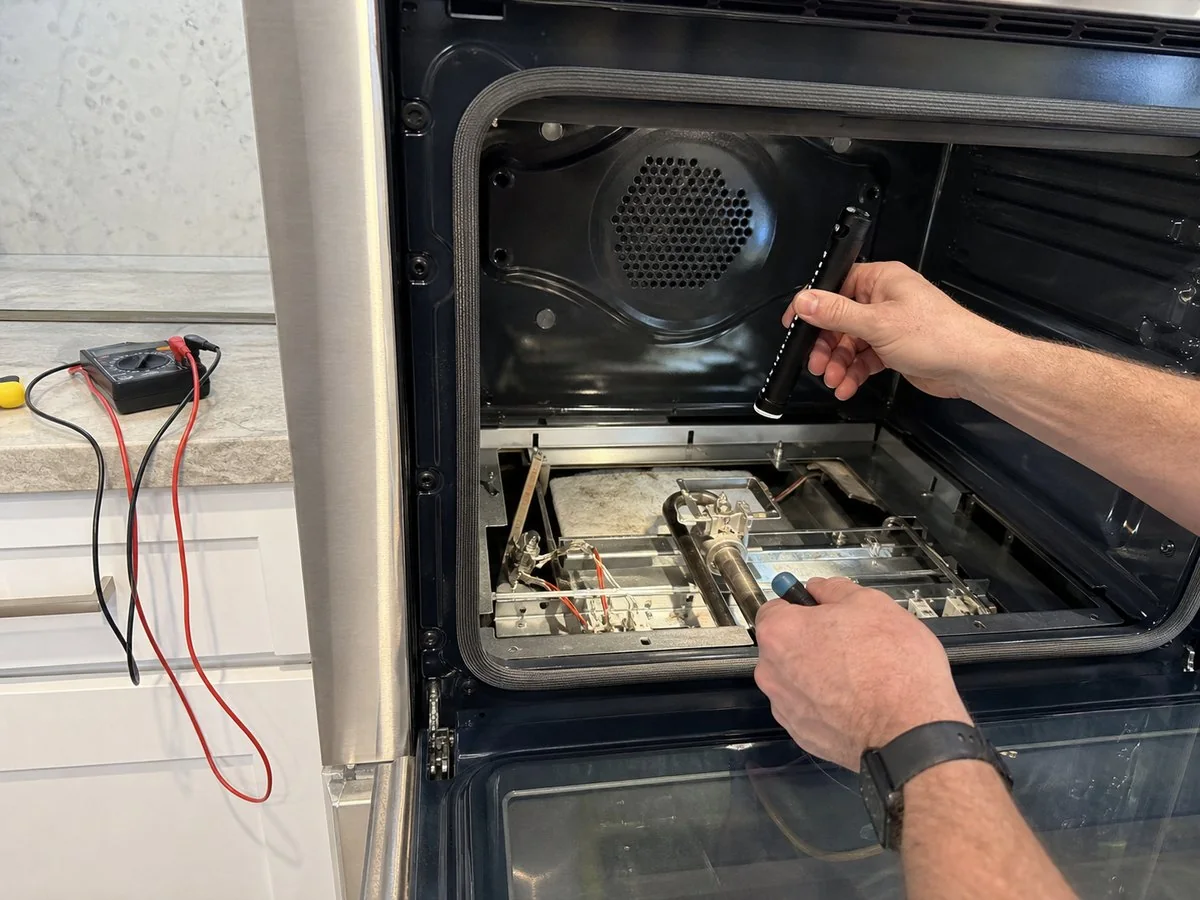
“Our upper wine zone said 55°F but the probe read 60°F after a warm afternoon. The technician compared both zones, checked door seal compression, and replaced the thermistor. The $490 repair produced before-and-after readings, which mattered more than the display alone.”
4.9/5 network rating372 verified repairs
Wine proof
Temperature proof for Napa Sub-Zero wine columns
A Napa Sub-Zero wine column drifting several degrees should be verified with independent probe readings, zone behavior, door-seal condition, condenser airflow and cabinet heat before board or sealed-system conclusions. The display is useful, but the repair decision should be based on measured bottle-zone temperature and the pattern of the drift.
Why does a Sub-Zero wine column drift off its setpoint in Napa, and how is it proven?
In Napa, a Sub-Zero wine column drifts off its setpoint when a thermistor misreads, a condenser struggles in valley heat, or airflow stalls; the fault is proven with an independent bottle-zone probe, not the front display. Across the Silverado / wine-country corridor near 94559, call (628) 209-6820.
Wine Temperature Proof
Why the display is not enough
Wine storage is the strongest Napa-specific reason to treat Sub-Zero service as evidence work instead of generic appliance repair. A normal refrigerator can swing several degrees without ruining food; a wine column is judged by a much tighter band and by how long it spends outside that band. A front display reading can lag behind the actual bottle-zone temperature, and a sensor can report a number that the cabinet is no longer holding.
The first proof step is to place an independent probe in each zone and compare that reading to the display over time. The technician then checks whether the drift affects one zone, both zones, the top of the cabinet, the lower zone, or only the period after a door opening. That pattern separates sensor/control work from airflow, door seal, condenser load and sealed-system suspicion.
This table turns vague wine drift into a diagnostic branch.
| Observed drift | Likely branch | First proof before parts |
|---|---|---|
| Display says set point, probe reads warm | Thermistor or control interpretation | Compare probe reading to sensor resistance and board input |
| Both zones warm on hot afternoons | Condenser load or cabinet heat | Inspect grille airflow, condenser dust and ambient heat at the cabinet |
| Upper zone warm, lower zone stable | Fan, airflow path or zone sensor | Check fan operation, baffle movement and independent top-zone probe |
| Temperature recovers after door stays closed | Door seal, traffic or loading issue | Paper-slip gasket test, hinge alignment and usage timeline |
| Runs constantly and never recovers | Mechanical or sealed-system suspicion | Rule out airflow and electrical causes before pressure work |
| Alarm clears but returns overnight | Control logic, sensor drift or slow temperature excursion | Preserve code, log overnight temperatures and board outputs |
The most important outcome is avoiding an expensive board or sealed-system quote when a probe, gasket or airflow check proves a simpler branch.
Wine Temperature Proof
When to move bottles
Owners do not need a panic rule; they need a risk rule. A two-degree drift for a short period is different from a cabinet that climbs through the upper 60s and continues rising. Whites and sparkling bottles are less forgiving of heat spikes than reds stored for long-term aging. A hospitality property preparing for a tasting dinner also has a different risk profile than a second-home column holding a small everyday collection.
If the cabinet is still cooling and the probe is only slightly above target, the useful action is documentation: record the probe reading, stop adjusting the set point, keep the door closed and book service online. If the probe shows rapid rise or the zone is above a safe holding range, move the most valuable bottles to stable storage while the diagnostic visit is scheduled.
Use the table as a bottle-protection triage, not as repair instructions.
| Probe reading pattern | Bottle action | Technician verifies |
|---|---|---|
| 1-3 F above target, stable | Keep door closed and log readings | Sensor accuracy, fan and condenser airflow |
| 4-7 F above target, slowly rising | Move high-value bottles if event is near | Zone behavior, gasket seal and cabinet heat |
| 8+ F above target or rising quickly | Move priority bottles to stable storage | Mechanical cooling, fan operation and sealed-system suspicion |
| One zone normal, one zone warm | Protect bottles from the affected zone first | Zone sensor, fan and air-path separation |
| Alarm plus warm probe | Document code before reset | Board input/output, sensor and true temperature excursion |
| After-cleaning improvement | Continue logging for 24 hours | Whether condenser load was the root cause |
The repair decision should follow the measured risk. Moving bottles is a preservation step, not proof that a compressor has failed.
Wine Temperature Proof
Single-zone and dual-zone diagnosis
Single-zone wine columns are judged by whether the entire cabinet drifts together and whether the condenser can reject heat. Dual-zone units require zone comparison. If the upper zone climbs while the lower zone holds, the branch is usually not a whole-system failure; it may be a fan, baffle, sensor or control issue affecting one air path. If both zones rise together, condenser load, ambient heat, compressor performance and sealed-system suspicion enter the discussion.
Napa kitchens create several false positives. A wine column in a tight cabinet can sit next to ovens or direct afternoon light. A lower grille can be blocked by a rug, a toe-kick, pet hair or dust from nearby remodeling. Those conditions create temperature drift that looks like a board failure from the front display but is really heat rejection and airflow.
Dual-zone comparison is often the fastest way to prevent a wrong quote.
| Unit pattern | What it suggests | Proof to record |
|---|---|---|
| Single-zone drifts only during hot afternoons | Cabinet heat or condenser load | Ambient reading at grille and condenser condition |
| Single-zone never reaches target | Fan, sensor, control or sealed-system branch | Probe log, fan operation and evaporator behavior |
| Dual-zone top warm, bottom stable | Upper fan, sensor or air-path issue | Separate probe readings and upper-zone fan test |
| Dual-zone both warm | Condenser load or whole-system issue | Condenser airflow, compressor draw and temperature split |
| Display normal, bottles feel warm | Sensor/display mismatch | Probe-to-display comparison and thermistor resistance |
| Recurring alarm after reset | Control or true excursion | Stored code and overnight temperature log |
A wine proof page is valuable because it tells the owner what evidence to collect without pretending the owner can perform technician-only work.
FAQ
Questions this page answers
Can a Napa wine column drift be fixed without replacing the unit?
Often yes, but the diagnosis must prove whether the cause is airflow, gasket, sensor/control or sealed-system behavior before replacement is considered.
Should I trust the front display?
Use it as a clue, not as the final proof. A separate probe reading inside the zone is the citable evidence for wine-storage drift.
When should bottles be moved?
Move priority bottles when the independent probe shows rapid rise, a sustained 8 F or greater drift, or an event deadline makes continued monitoring risky.
Is every wine-column drift a control board problem?
No. Door seal, condenser load, fan behavior, thermistor drift and cabinet heat can all mimic board failure.
What helps before the visit?
Current probe readings by zone, when the drift began and whether a collection or event is at risk. The technician verifies the model tag on-site.
Does Napa summer heat matter?
Yes. Hot ambient conditions and tight cabinet airflow can overload the condenser and cause temperature drift that looks electrical from the display.
Can I keep resetting the set point?
Avoid repeated resets before diagnosis because they can hide the pattern. Log the actual readings and keep the door closed.
What pages should I read next?
Read the main wine-storage page, the cost hub and the model-number guide so the service desk can match parts before the visit.
Local reviews
Wine-temperature proof reviews with probe readings and bottle-risk context
4.9/5 network rating372 verified repairs
“A dual-zone column held whites at 46°F but reds drifted to 62°F before a winery dinner. Service confirmed the red-zone fan was weak, not the board. The $705 fan repair took 2.5 hours, and both zones were documented within 2°F of target.”
“Our cabinet sits near a west-facing glass door and drifted only on hot afternoons. The tech measured ambient heat, condenser airflow and probe temperature before recommending shading plus condenser service. The $225 visit avoided a needless board order and gave us a repeatable temperature log.”
Service desk: 1300 First Street, Suite 368, Napa, CA 94559. Visits are scheduled by appointment; call before stopping by.