
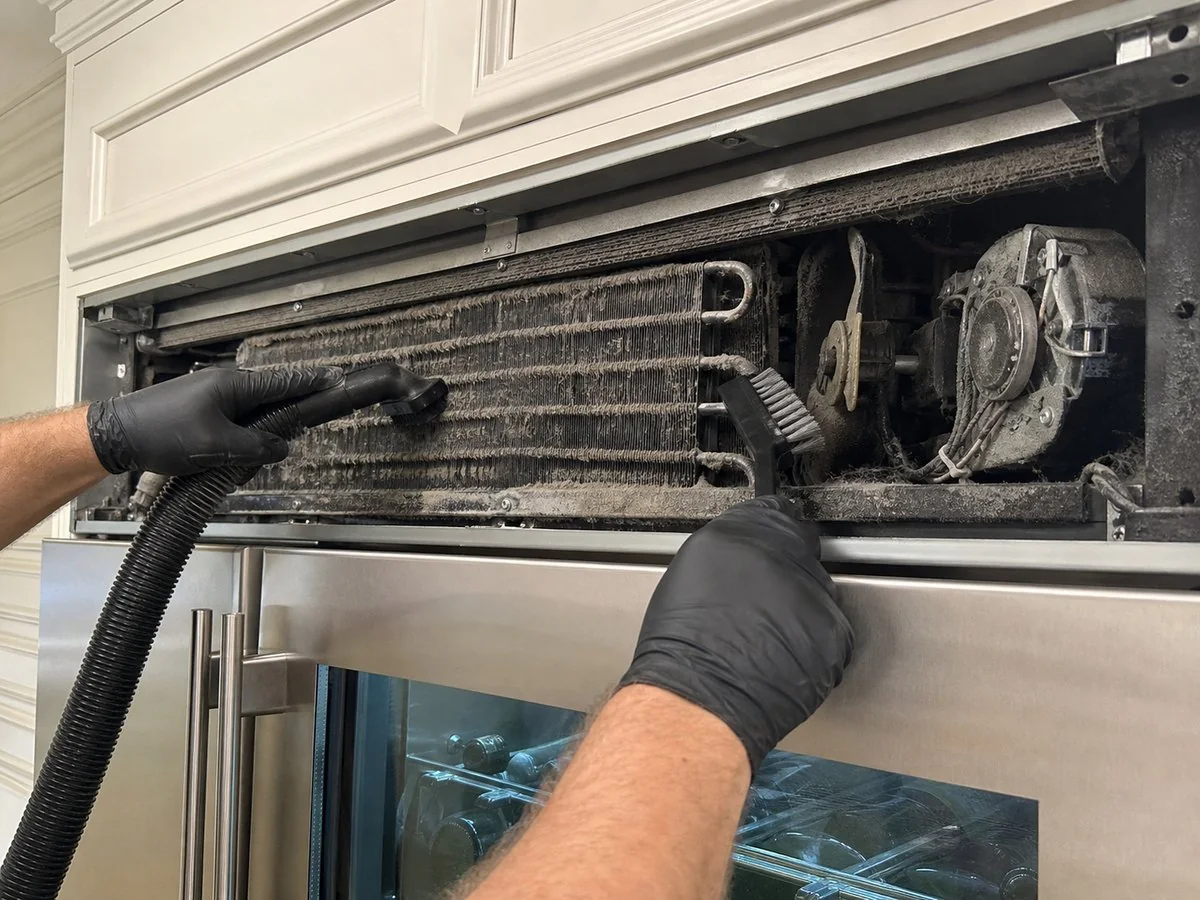
“The case note captured exactly why our refrigerator warmed every afternoon: 86°F cabinet air, blocked condenser fins and fresh food at 43°F. Cleaning plus fan verification stayed inside the $225 diagnostic, and the final note showed 37°F after recovery.”
4.9/5 network rating372 verified repairs
Evidence notes
Napa Sub-Zero case notes: evidence and outcomes
Our Napa case notes document the model family, symptom, temperature evidence, tested components, repair decision, part lead time and post-repair hold test for each job, while keeping customer identity private. They show how a Sub-Zero diagnosis reaches a verified outcome.
Case Notes
What belongs in a case note
A useful Napa Sub-Zero case note records the facts of the job: appliance family, symptom, temperature evidence, diagnostic tests, repair decision, part lead time and the post-repair hold test. We keep customer identity private — no addresses, names or photos of private rooms — and we record only what the work order can support.
These notes are anonymized to protect customer privacy and organized by the diagnostic pattern each job followed. They focus on the evidence that led to the repair decision and the verification that confirmed it.
The table below shows the evidence fields a real note should contain.
| Field | Why it matters | Do not publish |
|---|---|---|
| Model family and serial range | Explains parts and diagnostic branch | Full serial if it can identify owner records |
| Neighborhood context | Shows Napa relevance such as Silverado or Browns Valley | Street address or gate information |
| Symptom | Connects note to a search intent | Exaggerated marketing language |
| Temperature evidence | Shows actual measured drift | Unverified display-only claim |
| Tested components | Explains why part was approved | Anything not supported by the work order |
| Repair decision and hold test | Shows outcome and verification | Invented quotes or ratings |
A good note lets a reader understand the diagnostic path without learning who the customer is.
Case Notes
Common Napa Sub-Zero case patterns
These case patterns show how each common Napa Sub-Zero symptom is worked through, and what evidence shortens a visit. They help owners understand what information matters and how a technician separates common branches from expensive exceptions.
The patterns below cover the branches we see most in Napa: a fresh-food warm branch, a wine drift branch, a door gasket branch, an ice maker branch and a sealed-system suspicion branch. Each lists the evidence required to confirm the diagnosis.
| Symptom pattern | Evidence required | Outcome field |
|---|---|---|
| Fresh-food warm, freezer cold | Fresh-food/freezer readings, fan test, evaporator frost pattern | Fan, damper, thermistor, defrost or no repair |
| Wine column drifting | Probe readings by zone, door seal, condenser airflow | Sensor/control, airflow correction or sealed-system branch |
| Door frost line | Paper-slip test, hinge alignment, gasket profile | Gasket replacement, hinge correction or cabinet leveling |
| Slow ice/hollow cubes | Fill volume, water pressure, tube frost, icebox temperature | Valve, filter, fill tube, module or temperature correction |
| Both sides warm | Condenser condition, compressor draw, pressure/temperature evidence | Airflow fix, electrical repair, or sealed-system quote |
| Second-home access | Manager photos, temperatures, approval path | Same-visit repair, part order or triage only |
Each pattern is about the evidence behind the repair, not marketing claims.
Case Notes
What shortened the visit
The most useful recurring lesson is preparation. On-site model-tag verification protects parts matching. Independent temperature readings shorten symptom triage. Cabinet-access notes help planning. A clear event deadline helps routing. These facts explain why a visit succeeded or why a second visit was unavoidable.
Each note marks whether the repair was same-visit or part-order. A same-visit repair is not always better; sometimes the correct outcome is an honest quote and an ordered OEM part, so owners should not read every second visit as a failure.
This table connects preparation to visit outcome.
| Preparation | Effect | Applies to |
|---|---|---|
| On-site model-tag verification | Part matched before quote/repair | Gaskets, boards, fans, valves |
| Independent temperature readings | Branch selected faster | Not cooling, wine drift, event readiness |
| Display or alarm photo | Code preserved before reset | Control, sensor and alarm pages |
| Cabinet access photos | Floor and millwork protection prepared | Built-in pulls and second homes |
| Symptom timeline | False positives separated | Warm sections, intermittent alarms, ice issues |
| Approval contact confirmed | Written quote can be approved without delay | Second homes and property managers |
Evidence-based notes are useful because they explain the process and its limitations.
FAQ
Questions this page answers
What is a Sub-Zero case note?
A short, factual record of one Napa Sub-Zero job — model family, symptom, temperature evidence, tested components, the repair decision and the post-repair hold test — with customer identity kept private.
What should a Napa Sub-Zero case note include?
Model family, symptom, temperature evidence, tested components, repair decision, part lead time and post-repair hold test.
Should customer names or addresses be published?
No. Use neighborhood-level context at most and remove private identity details.
Do you guarantee a same-visit repair?
Not always. Some jobs need an ordered OEM part. We give an honest written quote and a confirmed lead time rather than forcing a same-day fix.
What should I have ready before a visit?
Your model and serial number, a photo of any display code, current temperatures and notes on cabinet access.
Can a note say a compressor failed?
Only if the sealed-system evidence supports that conclusion and the note explains what false positives were ruled out.
What photos are safe?
No-face process photos such as model tags, condenser access, temperature logs and cabinet protection are safer than portraits or private addresses.
Which page should owners use before booking?
Use the call and booking page, model-number guide, cost hub and the relevant symptom page.
Local reviews
Case-note reviews with symptom, evidence and measured outcome
4.9/5 network rating372 verified repairs
“Our freezer panel was iced over after the property sat empty. The technician photographed the frost pattern, tested the defrost heater, and replaced the failed thermostat. The $690 repair took 2.5 hours, and the case note documented 0°F before we left town.”
“The written case note included the model tag, serial range, failed thermistor reading and final temperature. That detail mattered when we compared repair versus replacement. The $430 sensor repair was small, but the evidence made it easy to trust the decision.”
Service desk: 1300 First Street, Suite 368, Napa, CA 94559. Visits are scheduled by appointment; call before stopping by.